About Phylloscartes ophthalmicus (Taczanowski, 1874)
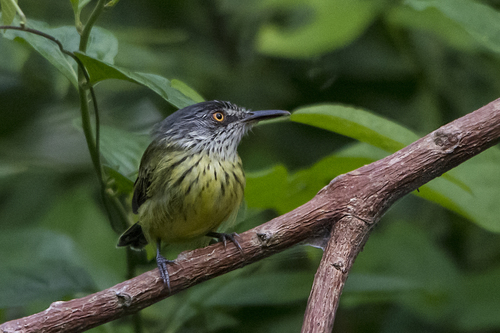
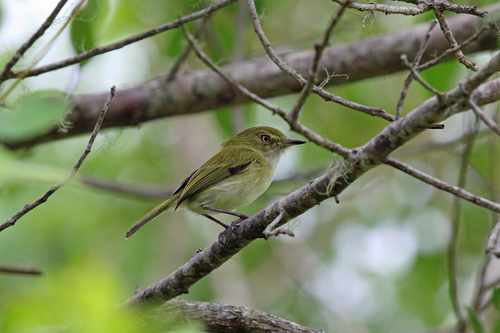
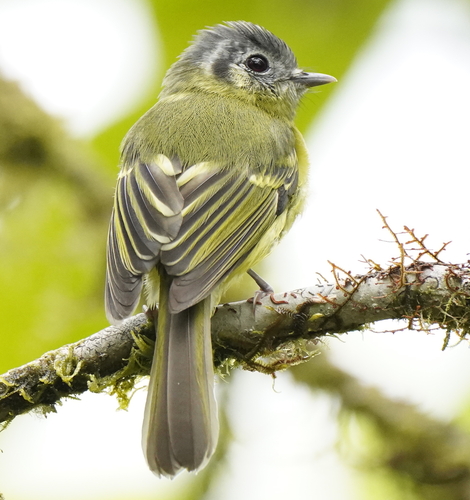
The marble-faced bristle tyrant (Phylloscartes ophthalmicus (Taczanowski, 1874)) measures approximately 11.5 to 12 cm (4.5 to 4.7 in) in length and weighs 10 to 11 g (0.35 to 0.39 oz). Males and females have identical plumage. Adults of the nominate subspecies have a slate-gray crown, white lores, and a white supercilium, set against an otherwise gray and white grizzled face. Their ear coverts are white to very pale yellow, marked with a black crescent at the rear. The back and rump are bright yellow-olive. Their wings are dusky, with pale olive-yellow to yellow edges along the flight feathers; the dusky wing coverts have pale olive-yellow to yellow tips that form two distinct wing bars. The tail is dusky olive. The throat is grizzled whitish, and the rest of the underparts are bright yellow, with a heavy darkish olive wash across the breast. Subspecies P. o. ottonis differs from the nominate with pale yellow wing bars, a grayish white throat and upper breast with a pale olive wash, and white to very pale yellow lower breast and belly. Subspecies P. o. purus has a brighter yellow face, more prominent wing bars, and brighter yellow underparts than the nominate subspecies. All subspecies of marble-faced bristle tyrant have a brown iris, a black bill that sometimes has a paler lower mandible, and gray legs and feet. The species has a disjunct distribution, with subspecies distributed sequentially from north to south. The northernmost subspecies, P. o. purus, occurs in the mountains of Venezuela's Yaracuy and southern Aragua states, and in the Venezuelan coastal mountains from Carabobo through Aragua into the Federal District. The nominate subspecies is found in Colombia's Central and Western Andes, on the western slope of the Andes in northwestern Ecuador south to Pichincha Province, along the entire eastern slope of the Andes in Ecuador extending slightly into northern Peru, and on the eastern slope of the Andes in Peru from southern Amazonas Department south to Ayacucho Department. P. o. ottonis occurs from Cuzco and Madre de Dios departments in southeastern Peru south into Bolivia as far as Santa Cruz Department. The marble-faced bristle tyrant lives in humid subtropical montane forest, where it favors mid-elevation moss-heavy cloudforest. It is found mostly in the forest interior, but will also enter clearings and forest edges. Its elevation range varies by country: between 800 and 1,700 m (2,600 and 5,600 ft) in Venezuela, between 1,000 and 2,400 m (3,300 and 7,900 ft) in Colombia, between 1,200 and 2,100 m (3,900 and 6,900 ft) in Ecuador, and between 750 and 1,800 m (2,500 and 5,900 ft) in Peru.