About Phylloporus rhodoxanthus (Schwein.) Bres.
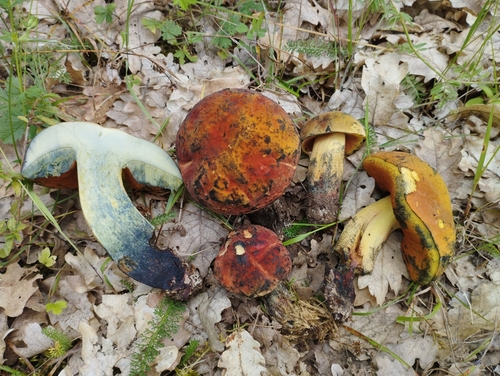
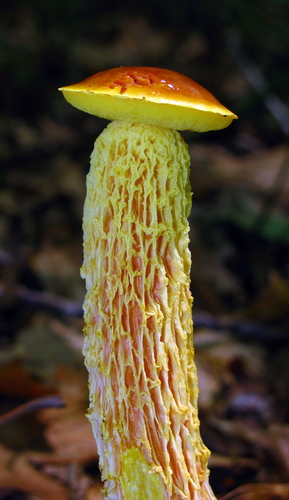
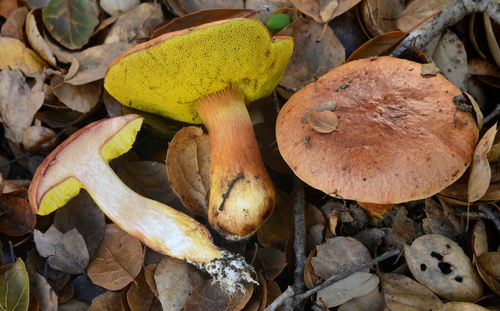
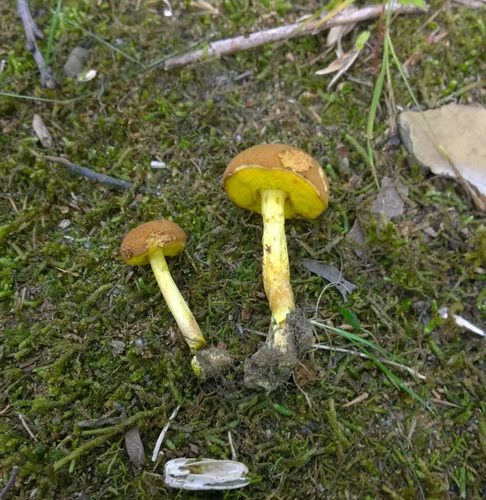
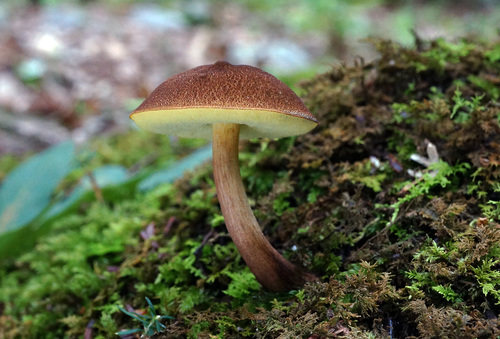
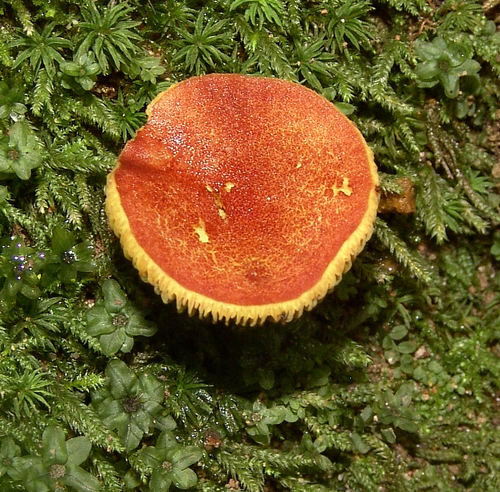
Phylloporus rhodoxanthus (Schwein.) Bres. has a cap that starts convex and flattens with age, sometimes developing a central depression. The cap reaches 2–12 cm (3⁄4–4+3⁄4 in) in diameter, with an initially inward-curved margin. The cap surface is dry, has a somewhat velvet-like texture, and often cracks when mature, revealing the pale yellow flesh underneath. Cap color ranges from dull red to reddish brown, reddish yellow, or olive brown. The flesh has no distinct taste or odor. The gills are decurrent to somewhat decurrent and well-spaced. They are deep yellow, stain greenish to brownish, are often wrinkled, and usually have cross-veins between them, which sometimes gives the gills a slightly pore-like appearance. The cylindrical stem is 4–10 cm (1+1⁄2–4 in) long and up to 7.5 cm (3 in) thick, and often tapers toward the base. The stem is firm and solid (not hollow), is yellow, and has yellow mycelium at its base. It frequently has longitudinal grooves running down from the gills. This species produces an olivaecous yellow-brown spore print. Its spores are elliptical to spindle-shaped, smooth, and measure 9–14 by 3.5–5 μm. Fruit bodies grow on the ground singly or in small groups in deciduous oak and beech forests. It has a wide distribution in North America, where it fruits from July to October, and has also been reported from Belize. The name was historically used for Phylloporus species found in Asia (China, India, and Taiwan), Australia, and Europe, but newer research confirms that these non-American records correspond to different species. The fruit bodies are edible, and some consider them a good edible species. Their flavor is described as "tender and nutty", and drying the fruit bodies first improves their flavor. Suitable culinary uses include sauteing, adding to sauces or stuffings, or using them raw as a colorful garnish. Hobbyists also use the mushroom to make mushroom dyes, which produce beige, greenish beige, or gold colors depending on the mordant used.