About Phylloporus pelletieri (Lév.) Quél.
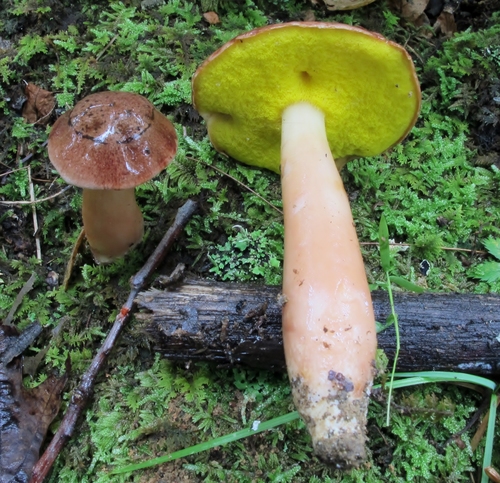
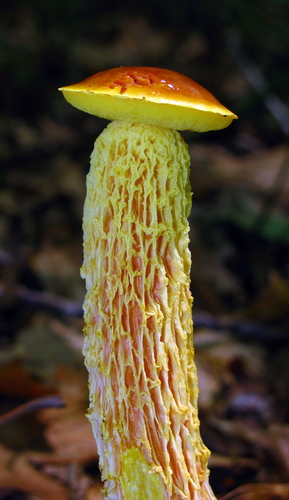
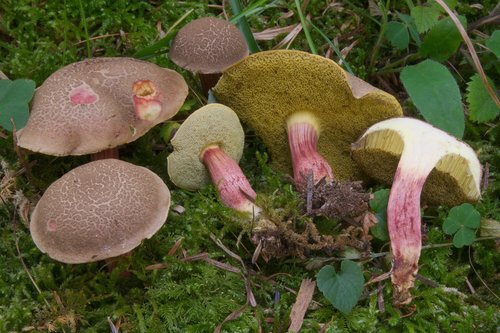
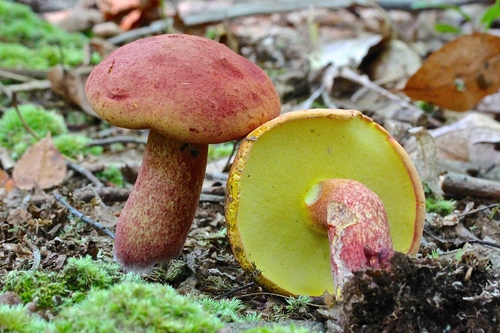
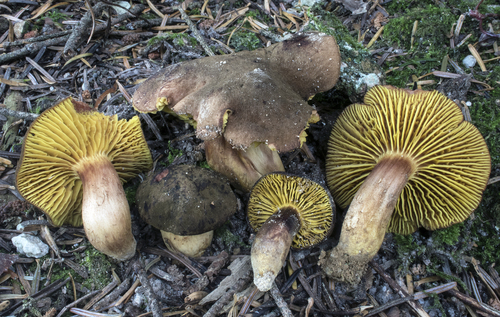
This species, commonly called the golden-gilled bolete, has the scientific name Phylloporus pelletieri (Lév.) Quél. The underside of its cap has lamellae, which are gill-like structures, instead of the pores that are common among species in the order Boletales. Its cap is reddish, domed, and has a smooth, velvety texture. The lamellae are bright yellow, and the stem that supports the cap is also yellow, with a red-brown veil. The golden-gilled bolete forms mycorrhizal relationships with broadleaved trees like beech, and coniferous trees like fir or pine. It produces fruit bodies in summer and autumn. Though it is a rare species, it has a widespread distribution across Europe, and its range extends into Asia. It grows in broadleaf or coniferous forests located in montane or sub-alpine regions, and is associated with acidic or sandy soils. This species is threatened by air pollution and forestry plantations, both of which can destroy its natural habitat. The European Council for Conservation of Fungi (ECCF) has short-listed it for inclusion in Appendix I of the Convention on the Conservation of European Wildlife and Natural Habitats, also known as the Bern Convention. It is currently included on the Red Lists of 12 European countries. Additional recommended conservation actions include mapping all known existing sites of the species, reducing levels of air pollution, and putting restrictions on forestry practice at locations where the species is known to occur.