About Phylloporus leucomycelinus Singer
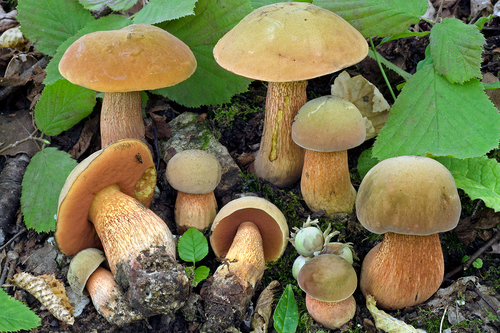
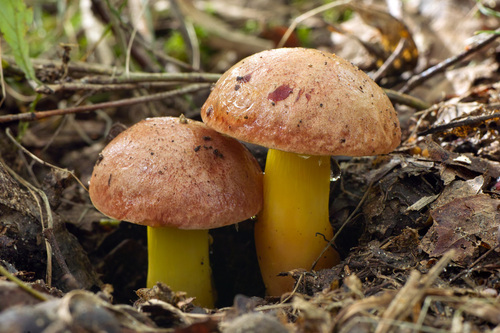
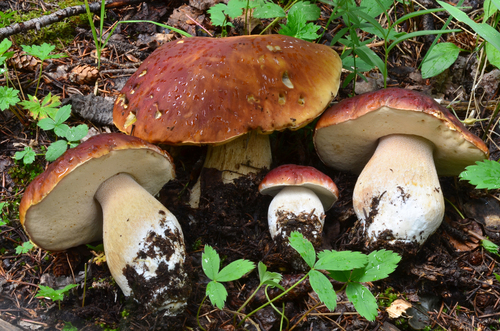
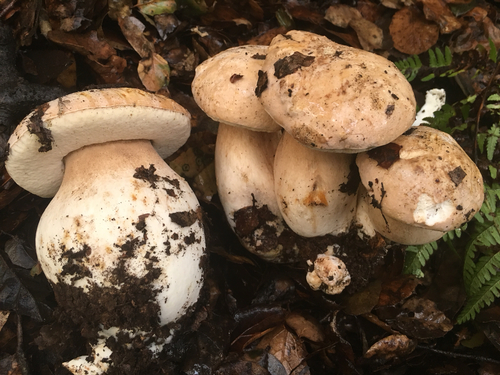
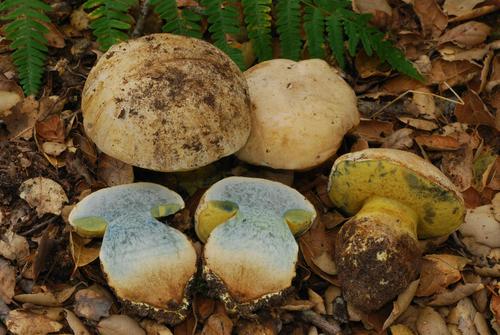
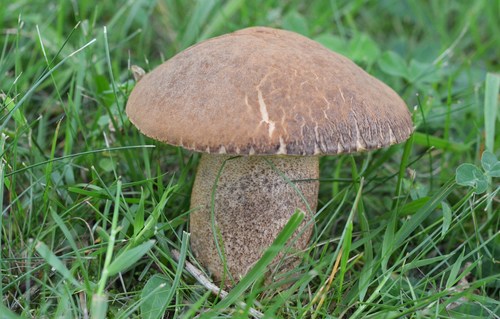
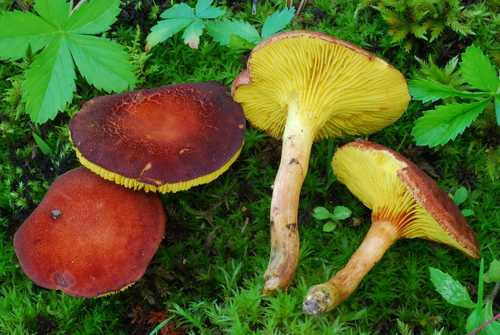
Phylloporus leucomycelinus Singer has a cap that starts out convex, then flattens as it matures, and sometimes develops a shallow depression. Mature caps reach 4 to 8 centimetres (1+1⁄2–3 inches) in diameter. The cap surface is dry, with a somewhat felt-like texture, and often cracks when mature. Cap color ranges from dark red to reddish chestnut, and mature individuals typically have a paler area in the center of the cap. Its flesh is whitish to pale yellow, with no distinctive taste or odor. The pores on the underside of the cap are quite similar to gills, are decurrent (meaning they run down the length of the stem), are yellow in color, are sometimes forked, and have cross-veins in the spaces between pores. The stem is 4–8 cm (1+1⁄2–3+1⁄4 in) long and 0.5–1.3 cm (1⁄4–1⁄2 in) thick. It is roughly equal in width along its length, or thicker near the base. It often has ribs near the top, and its surface has small brown dots and points. The overall stem color is yellow with reddish tinges, and white mycelium is present at the base of the stem. This species produces a yellowish spore print. Its spores are roughly elliptical to spindle-shaped, smooth, and measure 8–14 by 3–5 μm. The spore-bearing basidia are ventricose (swollen in the middle), four-spored, and measure 20–25 by 6–7 μm. Fruit bodies of P. leucomycelinus grow scattered or in groups on the ground in deciduous forests, usually near beech and oak trees. The species is found in North America, where its range extends from eastern Canada south to Florida, and west to Michigan. In 2010, it was reported growing in a Mexican beech (Fagus mexicana) forest in Hidalgo, Mexico. It has also been collected in the Philippines. This mushroom is edible. Its fruit bodies can be used for mushroom dyeing to produce beige, gold, or greenish-beige colors, depending on the mordant that is used.