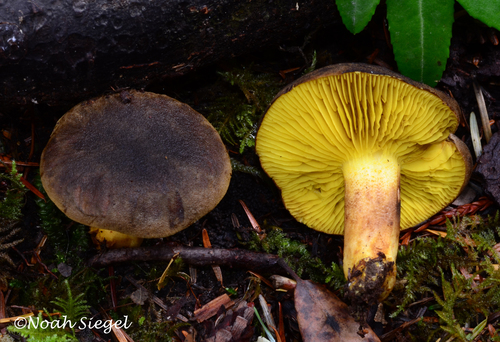
About Phylloporus arenicola A.H.Sm. & Trappe
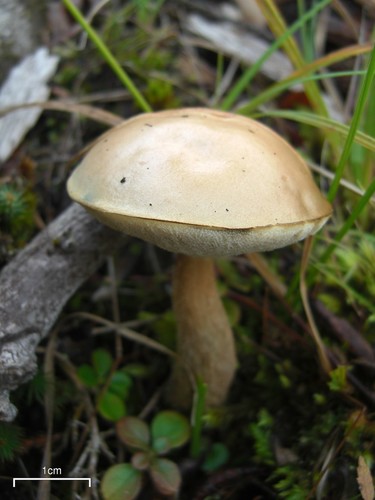
The fruit bodies of Phylloporus arenicola have caps that start convex before flattening as they mature, and sometimes develop a central depression. Mature caps reach a diameter of 1.5–4.5 centimetres (1⁄2–2 inches). The cap surface is dry with a velvet-like texture, and its color changes from dull olive with a darker center when young, to olive-brown, and finally fades to pale brown. The whitish to yellowish flesh does not change color when exposed to air, and has no distinctive taste or odor. The pore surface on the underside of the cap is bright yellow when young, and fades slightly as it matures. The pores, which resemble the gills of agaric fungi, form tubes that extend 3–7 millimetres (1⁄8–1⁄4 in) deep. The stipe is 4–6 cm (1+1⁄2–2+1⁄4 in) long by 5–8 mm (1⁄4–3⁄8 in) thick, and is thicker near its base. It is solid (not hollow), dry, and has a dull yellow base color partially covered by reddish-brown pruina (dots) and fibers. Internal tissue is bright red at the stipe base, and pale yellow near the upper stipe. Spores are somewhat elliptical to spindle-shaped (tapered at both ends), smooth, and measure 9–12 by 4–5 μm. The club-shaped, spore-bearing basidia are four-spored and measure 38–60 by 9–13 μm. There are no clamp connections in the hyphae. Testing the cap cuticle with ammonia solution turns it a violet, brownish gray color. The spore print of this species is olive brown. Fruit bodies grow singly, scattered, or in groups on the ground in sand dunes. Phylloporus arenicola is a mycorrhizal species that forms associations with pine trees. This fungus is found in the Pacific Northwest region of western North America, and has been recorded in California, Oregon, and Washington. Fruiting occurs from July to September in the Mountain states, and from November to May on the West Coast. P. arenicola is one of only three North American Boletaceae species that grow in coastal sand dunes; the other two are Leccinum arenicola from New Brunswick, Canada, and Boletus abruptibulbus described from the Gulf Coast of the Florida panhandle.