About Phyllodes imperialis Druce, 1888
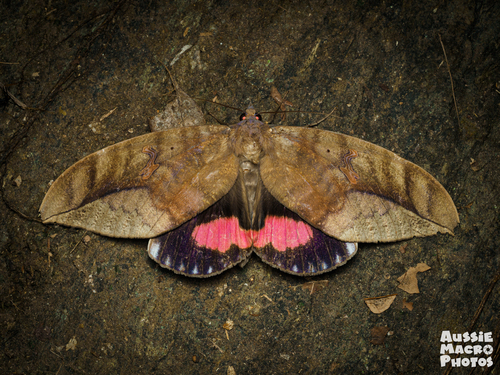
Phyllodes imperialis Druce, 1888, commonly called the pink underwing moth, has a wingspan ranging from 130 to 170 millimetres, or 5.1 to 6.7 inches. Its forewings are leaf-shaped, grey-brown, and bear a distinctive white or yellow marking that varies slightly between different populations. On the ventral side of the forewing, there is a dark-brown discal patch that holds three white spots. The hindwings are dark brown to black, with a large central pink patch that extends to the inner margin; this pink patch gives the species its common name of pink underwing moth. Early instar caterpillars are dull brown, though green individual caterpillars have also been observed. Mature caterpillars are dark brown to reddish brown, and display large eyespots. Each eyespot is made up of a black pupil, surrounded first by a blue ring, then a yellow ring. Between and below these eyespots are white markings that are often described as looking like teeth, and they resemble the teeth of a cartoon skeleton. The larvae of this moth feed on species from the Menispermaceae family, including Carronia multisepala and Pycnarrhena australiana.