About Phyllocladus trichomanoides D.Don
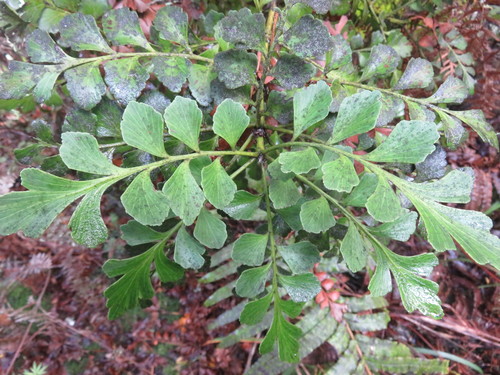
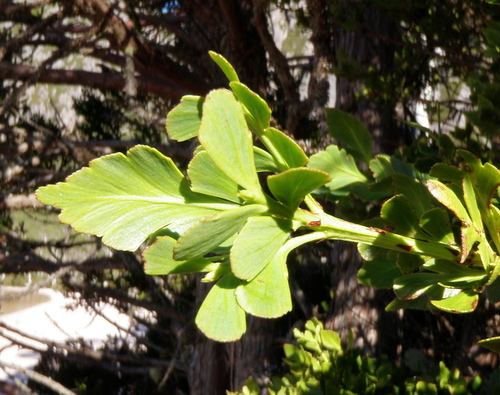
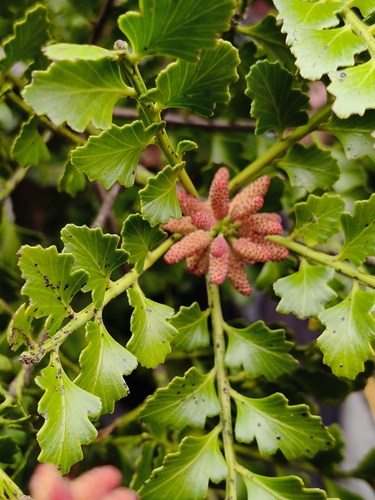
This species, commonly called tānekaha, is a medium-sized forest tree that reaches up to 25 metres (82 feet) in height, with a trunk diameter of up to 1 metre. Its main structural shoots have green skin for 2–3 years, then turn brown as their bark thickens. Tānekaha produces sparse, tiny, scale-like leaves that are 2–3 mm long; these leaves are only green and photosynthetic for a short time, and turn brown soon after development. Most of the species' photosynthesis is carried out by phylloclades, which are highly modified short shoots that resemble leaves. These phylloclades are arranged alternately, with 10–15 growing on one shoot. Individual phylloclades have a rhombic shape, and range from 1.5 cm to 2.5 cm in length. The seed cones of tānekaha are berry-like, with a fleshy white aril that surrounds but does not fully enclose the single seed inside each cone. In the North Island of New Zealand, this species occurs in lowland forests from Te Paki down to 40°S. In the South Island of New Zealand, it is found in northern Marlborough and Nelson, ranging as far south as 41°30'S. Like kauri, tānekaha naturally sheds its lower branches, producing smooth, straight trunks that yield knot-free timber. This timber is sought after for its strength. The bark of tānekaha is rich in tannin; Māori historically extracted a red dye from this bark.