About Phyllanthus warnockii G.L.Webster
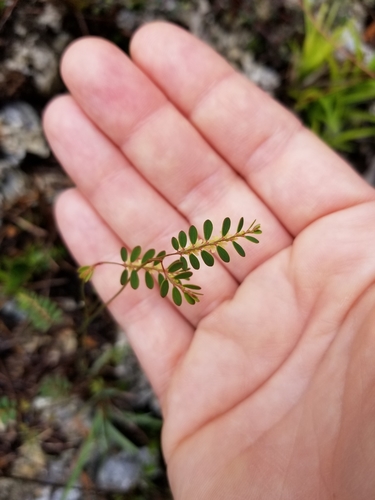
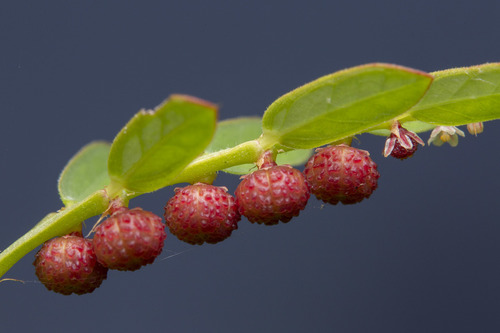
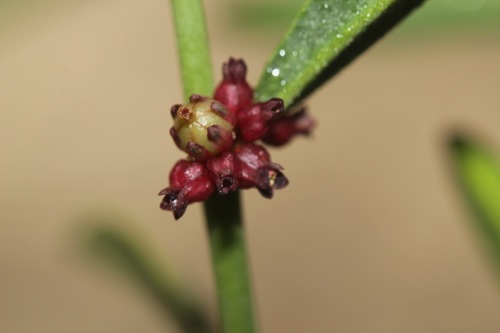
Scientific name: Phyllanthus warnockii G.L.Webster. Common name: Sand reverchonia. This is a herbaceous annual plant that grows 10 to 50 centimeters tall, usually no taller than 30 cm. It grows from a taproot with very little branching. It is monoecious, meaning it produces separate pollen-producing and seed-producing flowers, with both flower types growing on the same individual plant. Stems grow straight upward, but plants often have numerous widely spreading, hairless side branches. The lowest branches can reach 20–30 cm long and 1.5–2 millimeters thick. The plant does not produce milky sap. Leaves are attached via short petioles, with unlobed, untoothed edges. They grow alternately along stems, and range in shape from linear-oblong (a very narrow rectangle with rounded corners) to narrowly elliptic (a shape with gently curved sides from base to tip, widest at the middle). Seed leaves (cotyledons) grow oppositely, and are enlarged to resemble narrow adult leaves. Adult leaves measure 1.5 to 4.5 cm long and 1.8 to 9 mm wide. At the base of each leaf are two small, reddish, papery stipules 0.7–2.3 mm long. Flowers form small clusters at the base of leaves on side branches. Each cluster has one central pistillate flower that will develop into fruit if fertilized, surrounded by four to six staminate pollen-producing flowers. Flowers are dark red-purple; staminate flowers have four sepals, while pistillate flowers usually have six, or less commonly five sepals. Staminate flowers measure 1.5–2.5 mm long and 0.7–1.5 mm across; pistillate flowers measure 1.3–2.9 mm long and 1.1–1.8 mm wide. The fruit is a spherical to slightly flattened capsule 7–10 mm across. Each capsule contains six seeds, with two seeds in each of the capsule's three chambers. Seeds are three-sided, and range in color from dark to red-brown. The two faces that face other seeds inside the capsule are smooth, while the outer face is papillate (somewhat bumpy) and has a groove along its inner edge. Seeds measure 4–6.5 mm long. Sand reverchonia is native to seven central and western US states, and to the state of Chihuahua in northeastern Mexico. In the United States, it grows in western Kansas, Oklahoma, and Texas. It is rare in Colorado, where it has only been recorded in Bent County. It is found in the three southernmost counties of Utah: Washington, Kane, and San Juan, and in three northern counties of Arizona: Coconino, Navajo, and Apache. In New Mexico, it grows in five widely scattered southern counties. In Chihuahua, it grows in the Samalayuca Dune Fields, located south of Ciudad Juárez in the northeastern corner of the state. It grows at elevations between 300 to 1,800 meters (980–5,910 ft), and its habitat is restricted to areas of quartz sands such as dunes. A 1960s limited experiment feeding this plant to confined sheep and cattle found it to be toxic. Sheep developed symptoms after being fed plant material equal to 1% of their body weight, while cattle were less affected. Experimentally fed animals developed acute liver and kidney damage; free-roaming affected animals developed chronic symptoms and extensive organ fibrosis. Toxicity symptoms are similar to those caused by Phyllanthus abnormis. Nothing is known about the identity of the toxin, or whether other mammals would be similarly harmed. Piki, a traditional corn wafer bread, is cooked on a flat stone cooking surface. Most often, cooks oil the stone using watermelon or squash seeds, but the fruits of sand reverchonia are sometimes used for this purpose. In 1905, H. R. Voth recorded that Hopi people living at Oraibi, Arizona used sand reverchonia as a medicine called táingwa, used similarly to the roots of "blood medicine" Eriogonum annuum to prevent postpartum hemorrhage. Voth did not record the method of preparation for this medicine.