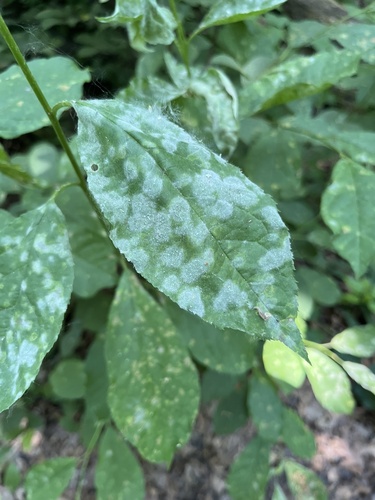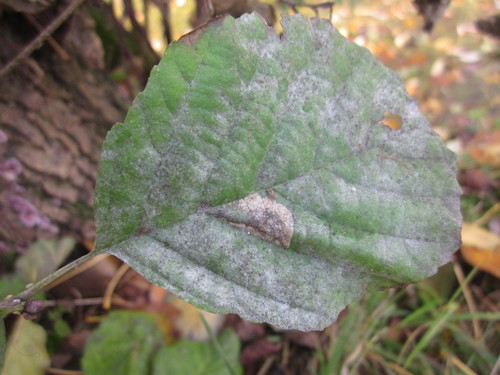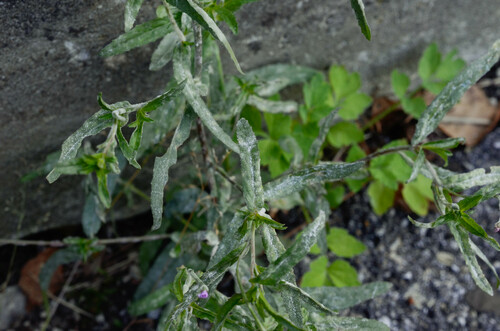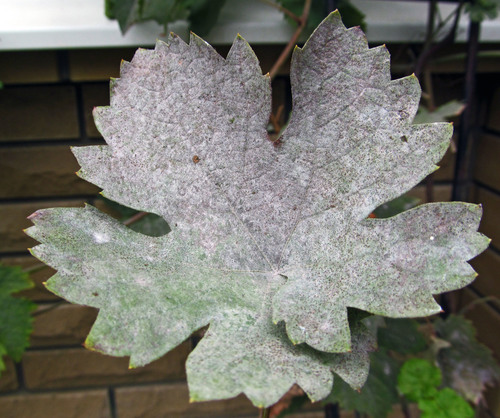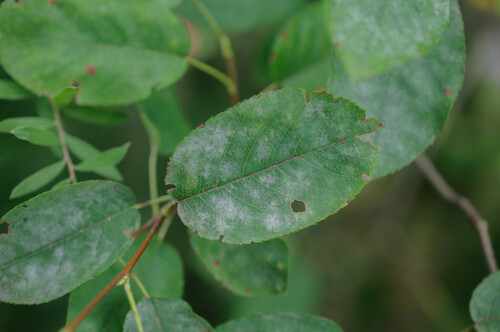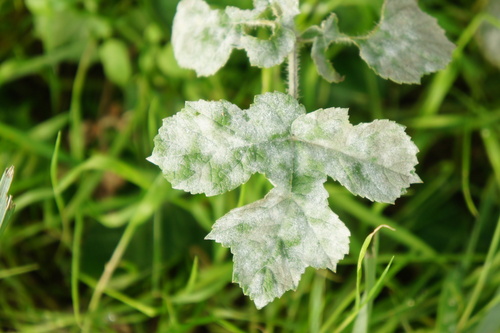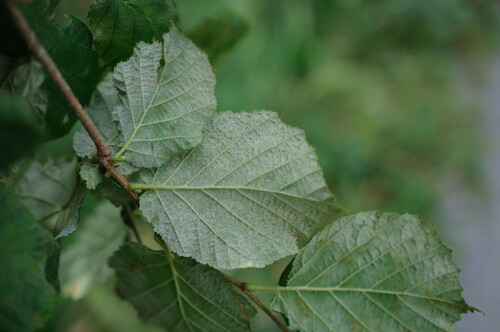
About Phyllactinia guttata (Wallr.) Lév.
The mycelium of Phyllactinia guttata may be abundant and persistent, or scant and short-lived (evanescent). Its cleistothecia can reach a large size of 216–245 μm, with soft wall tissue, obscure cellular structure, and cracks and wrinkles called reticulations. Cleistothecia typically develop 8–12 easily detachable hyaline appendages, which vary in length from 191–290 μm. This species produces between 4 or 5 to 20 or more asci, which are ovate and pedicellate (supported by small stalk-like structures), measuring 72–83 by 32–40 μm. There are typically 2 spores per ascus, sometimes 3 or 4, and spores measure 31–36 by 21–25 μm. Hair-like cells attached to the upper part of the ascomata are called penicillate cells; they are made of foots and filaments. The filaments can gelatinize when they absorb water, and are thought to help ascomata adhere to the surface they grow on, such as the underside of leaves. In P. guttata, the foots are cylindrical, irregular in width, measure 32–72 by 7.5–25 μm, and divide into 2–10 branchlets in their upper portion. Each branchlet is short and bulbous, with filaments measuring 20–42 μm, which are somewhat shorter than the foots. The foots themselves are 2–4 μm wide. The short, bulbous branchlets found on the multi-branched upper portion of the foots are unique among species of Phyllactinia, and form a distinguishing taxonomic characteristic of P. guttata. Phyllactinia guttata is distributed throughout temperate regions of the world. P. guttata acts as a host for the fungicolous hyphomycete Cladosporium uredinicola.