About Phycodrys rubens (L.) Batters
Species Overview
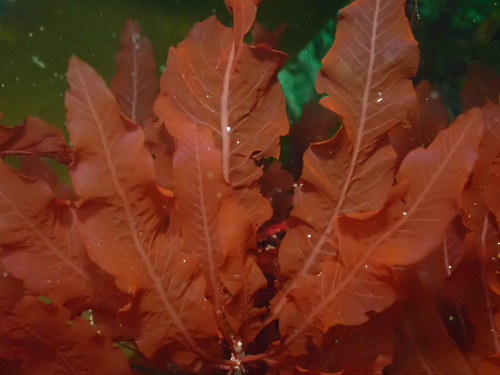
Phycodrys rubens (L.) Batters is a perennial red seaweed that can grow up to 30 cm long, with a deep red color. It produces flat, leaf-like blades that are monostromatic, meaning they are made of a single flat layer of cells, and can reach up to 3 cm wide.
Blade Morphology
The blades have a distinct visible mid-rib, with paired lateral veins branching out from the central mid-rib, and a ruffled margin. The entire organism grows from a small disc-shaped holdfast connected to the blades via a short stalk.
Similar Species Distinction
This alga is similar in appearance to Delesseria sanguinea, which also has a deep red color, but Delesseria sanguinea has a smooth rather than toothed margin. The overall shape of Phycodrys rubens' frond resembles the leaf of an oak tree.
Habitat Zones
Phycodrys rubens is most commonly found in the littoral and sub-littoral zones, growing in low rock pools and attached to the stipes of large algae such as Laminaria. It can be found at depths down to 30 meters.
British Isles Distribution
In the British Isles, it is common on the shores of Ireland, Wales, the Isle of Man, Scotland (including the Shetland Islands), and north-east England. It is not found in south-east England.
Broader Distribution Range
More broadly, the species occurs throughout the North Atlantic, ranging from Spitzbergen to Portugal and also along the coasts of Canada.
Reproductive Trait
For reproduction, Phycodrys rubens gametophytes are dioecious, meaning male and female reproductive phases occur on separate individual plants. Its reproductive structures are located on the blade margins: cystocarps grow as branches attached to the veins, while tetrasporangial sori develop near the tips of larger bladelets.