About Phrynosoma platyrhinos Girard, 1852
Common Name and Identifying Feature Context
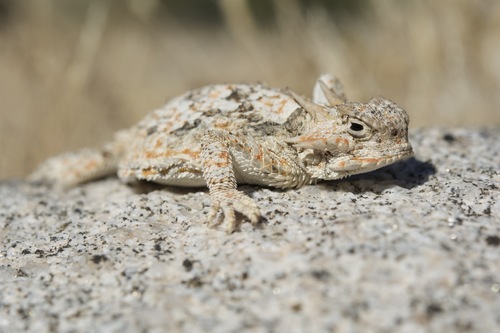
Phrynosoma platyrhinos, commonly called the desert horned lizard, has key identifying features that set it apart from other horned lizards and other lizard species more broadly.
Horned Lizard Distinguishing Traits
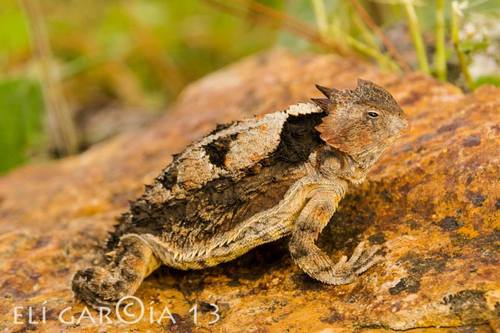
All horned lizards can be distinguished from other lizards by large pointed scales protruding from the back of the head, which create a horn-like appearance, plus their characteristic flat, broad body shape. P. platyrhinos specifically has a distinctive flat body with one row of fringe scales running down each side of its body.
Size
This is a medium-sized lizard that grows to approximately 3.75 inches (95 mm) in length.
Throat Scales
It also has one row of slightly enlarged scales on each side of the throat.
Dorsal Base Coloration
Its body coloration is variable and generally matches the color of surrounding soil; most individuals have a beige, tan, or reddish back (dorsum) marked with contrasting, wavy darker blotches.
Neck Blotches
It has two very prominent dark blotches on the neck, which are bordered on the rear (posterior) side by light white or grey color.
Additional Dorsal Markings
Scattered pointed scales and additional irregular dark blotches are also present across the dorsum.
Dorsal Stripe Trait
Unlike many other horned lizard species, P. platyrhinos does not have a prominent dorsal stripe; any dorsal stripe is faint or entirely absent in this species, varying by individual.
Dorsal Scale Coverage
Pointed scales also cover the dorsum (back) of the body.
Juvenile Morphology
Juvenile desert horned lizards resemble adults, but have shorter, less pronounced cranial spines.
Horn Morphology vs Short-Horned Lizard
The horns of P. platyrhinos are wide at the base, which is not the case for the closely related short-horned lizard.
Horn and Fringe Scale Comparison to Blainville's Horned Lizard
Additionally, the horns of desert horned lizards do not touch one another at their base, unlike the Blainville's horned lizard (Phrynosoma blainvillii), which has colored horns and a double row of fringed scales along its body.
Current Distribution Range
The current distribution of P. platyrhinos extends from southern Idaho in the north to northern Mexico in the south, and the species occurs across desert climate regions of western North America.
Range Country Specifics
Within this range, it is found in the United States in southeastern Oregon, California, western Arizona, Utah, Idaho, and Nevada; outside the United States it occurs in northwestern Sonora and northeastern Baja California, Mexico.
Historical Range Shifts
Geographic range shifts have affected P. platyrhinos over time.
Post-Last Glacial Maximum Habitat Expansion
After the Last Glacial Maximum (LGM), which ended approximately 21,000 years ago, deserts expanded across western North America. This expansion created more suitable habitat for the species, and P. platyrhinos was able to spread north into the Great Basin, which is now part of its current range.
General Habitat Regions
Desert horned lizards occupy diverse habitats, and are found mostly in the Sonoran and Mojave deserts.
Preferred Habitat Characteristics
The species prefers areas with shrub cover and an understory.
Burrowing Behavior
When possible, P. platyrhinos often buries itself in sand soil, and it will also occupy burrows built by other animals.
Sympatric Horned Lizard Habitat Differences
Different related horned lizard species occupy different habitats: the flat-tailed horned lizard lives in areas with fine sand, the short-horned lizard (P. douglasii) occurs in shortgrass prairie up to spruce-fir forest, and the regal horned lizard (P. solare), the most common species in the Arizona Upland subdivision, is found in rocky or gravelly arid to semiarid plains, hills, and lower mountain slopes.