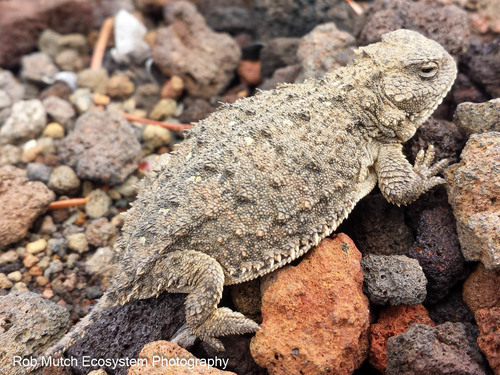
About Phrynosoma douglasii (Bell, 1829)
Species Misidentification
The pygmy short-horned lizard (Phrynosoma douglasii) is often mistaken for its close relative, the greater short-horned lizard (P. hernandesi), because both share many physical traits.
Both have a squat body and small, horn-like pointed scales along the head, back, and sides of the body.
Taxonomic History
Before new mitochondrial DNA evidence was published, the greater short-horned lizard was considered the same species as the pygmy short-horned lizard.
The two are now recognized as separate species.
Distribution
The pygmy short-horned lizard occupies the northwest part of the United States; it formerly lived in extreme southern British Columbia, Canada, but is now extirpated there.
Size Difference Between Species
When the two species are compared directly, mature individuals are easy to tell apart, because the pygmy short-horned lizard is considerably smaller.
Greater Short-Horned Lizard Variability
The greater short-horned lizard is a highly variable species, with different geographic populations showing differences in coloration, patterning, and overall size.
Some authorities recognize up to five subspecies of greater short-horned lizard.
Pygmy Short-Horned Lizard Size
The pygmy short-horned lizard measures roughly 1.25–2.5 inches (3.2–6.4 cm) from snout to vent (SVL).
Body Morphology
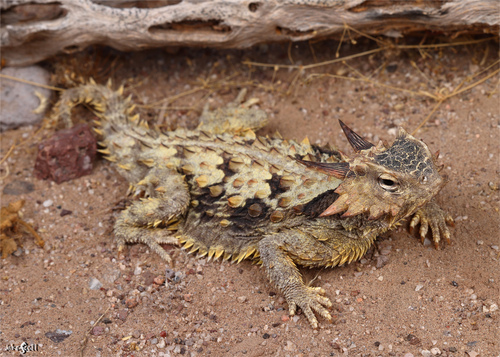
It is a flat-bodied, squat lizard with short, non-sharp spikes that crown the head.
Compared to the sleeker snouts of many other lizards, it has a snub-nosed side profile, and it has relatively short legs.
Scale Characteristics
A single row of pointed scales fringes the trunk, while the scales on its belly are smooth.
Base Coloration
Its base color is greyish-beige, yellowish, or reddish-brown, varying by season and geographic region.
It also has two rows of larger, dark spots running along its back.
Color Intensity Change
When the species is ready to mate, feels threatened, or reacts defensively, its colors become more intense, a change commonly called being "fired-up".