About Phrynocephalus versicolor Strauch, 1876
Total Length
Phrynocephalus versicolor Strauch, 1876 reaches a total length of approximately 13 cm (5 in) when including the tail. Its tail is longer than the combined length of the head and body.
Head Morphology
The head is large and rounded, with a blunt snout that has an oblique profile. This snout shape makes the lizard's nostrils easily visible when viewed from above.
Shoulder Skin
There is no transverse fold of skin across the lizard's shoulders.
Spinal Scales
Large, smooth, unribbed scales run along the lizard's spine.
Dorsal Body Scales
Other scales on the dorsal (upper) surface of the body are thickened, with slightly raised rear margins. This texture gives the lizard a rough overall appearance.
Ventral Scales
Scales on the ventral (lower) surface are modified into short spines.
Tail Structure
The tail is long and tapering; it is flattened at the base and becomes cylindrical further from the body. Males have a thicker base to the tail than females.
Dorsal Body Coloration
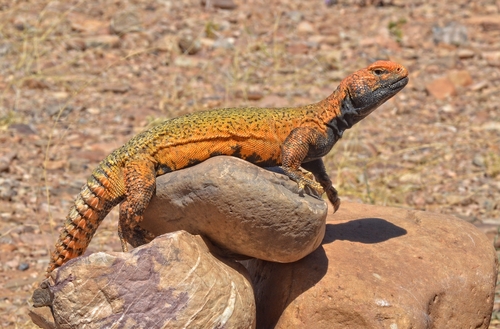
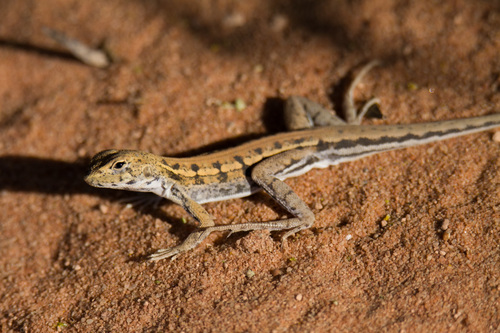
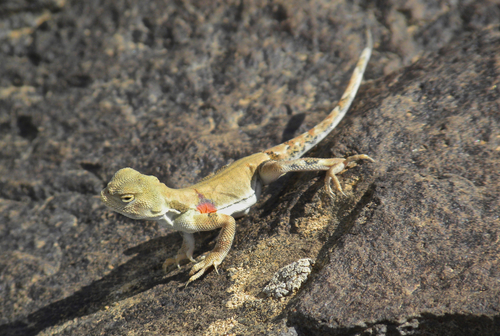
The lizard's body coloration is variable. The dorsal surface is typically olive or leaden-grey, marked with two to five transverse brownish-black bars.
Armpit and Leg Markings
The darkest bars are located just behind the shoulders, and an orange patch is often present in the armpit region. The legs are also marked with darker colored bands, and the underparts of the body are white.
Tail Coloration
The tail has up to nine dark bars, some of which extend onto the underside of the tail, and the tip of the tail is black on its underside.
Geographic Range
This species occurs in Mongolia, and in the Chinese provinces of Xinjiang, Gansu, Ningxia, and Nei Mongol.
Habitat Type
It inhabits stony plains and slopes, canyons, and sand dunes that support sagebrush and other sparse scrubby vegetation.
Habitat Elevation
Most of the species' habitat lies above 3,200 m (10,500 ft) in elevation.
Temperature Range
Temperatures in its range can vary from −30 °C (−22 °F) in winter to 40 °C (104 °F) in summer.
Precipitation Pattern
Precipitation in this habitat is very low, and any small amount of rainfall is concentrated in mid-summer.