About Phratora vitellinae (Linnaeus, 1758)
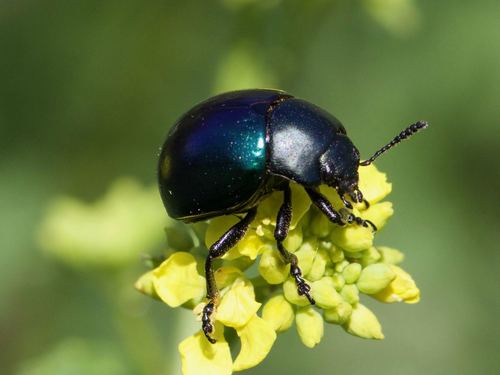
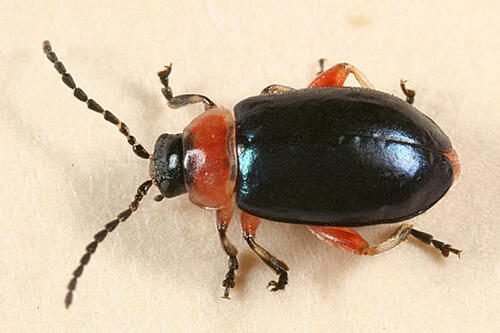
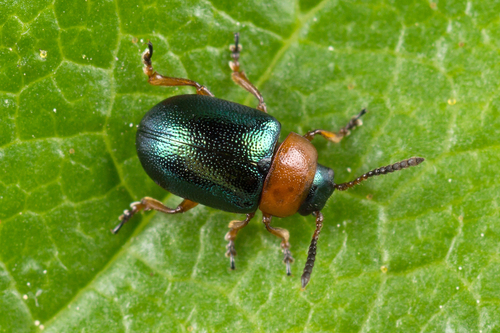
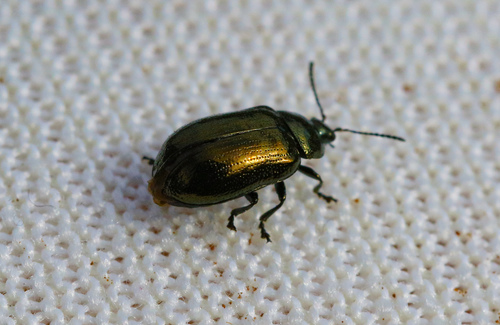
Adults of Phratora vitellinae measure 3.5–5.2 mm in body length. Their opaque forewings (called elytra) have clearly visible longitudinal rows of dots. Most adult individuals have metallic blue, green, or bronze coloration; those found at high elevations or in Arctic regions are copper or purple. To identify adult Phratora beetles that occur together on the same host plant, you can gently squeeze the abdomen of female individuals to observe their genitalia morphology from the ventral side. Female P. vitellinae have a wide, smooth, sclerotized plate that runs parallel to the posterior end of the abdomen. P. vitellinae lays eggs in clutches of 8 to 16, arranged in rows on the underside of host plant leaves. Like other species in the Phratora genus, P. vitellinae eggs are partially covered with a crusty secretion. Eggs measure approximately 0.8–1.0 mm long and 0.4–0.5 mm wide. Early instar larvae feed together in groups. When P. vitellinae feeds on Populus, it often shares this host with two other Phratora species: Phratora laticollis and Phratora atrovirens. Common name the Brassy Willow Beetle, P. vitellinae is larger and more abundant than P. atrovirens, and has a somewhat broader body shape than P. laticollis. When P. vitellinae populations live on Salix purpurea, they sometimes co-occur with Phratora tibialis, which has a thinner body than P. vitellinae. Phratora vitellinae is a widespread species native to Eurasia. In Europe, it occurs in Arctic regions, Nordic countries, the United Kingdom, from Germany to Spain, and in Serbia and Bosnia. It is also found in China and other parts of Asia, and occurs at high elevations in parts of central Europe and China. The species was introduced to Iceland in 2005, where it is classified as an invasive species. P. vitellinae is widespread and common, and has an unusual mechanism: it metabolizes secondary compounds from its host plants to produce its own defensive secretion. For decades, researchers have studied how host plant chemistry relates to the suitability of potential host plants for P. vitellinae diet, as well as how its host-derived defensive secretion affects natural enemies. These studies have often focused on generalist predators, which are relatively easy to use in laboratory feeding trials. Below is a summary of key representative studies of host plants and laboratory predators. In 1984, Rowell-Rahier published paired studies of field observations of P. vitellinae on different host plants in eastern France, and laboratory tests of P. vitellinae feeding preferences. She found that P. vitellinae favored salicylate-rich willows and poplars over the salicylate-poor willows Salix caprea and Salix cinerea. Both salicylate-poor species have dense hairs (trichomes) on the undersides of their leaves, which may repel P. vitellinae. Notably, Phratora vulgatissima frequently uses these salicylate-poor hosts, showing that some Phratora beetles can overcome the potential physical defense of leaf trichomes. In 1985, Tahvanainen et al. published a study of host plant preferences in four species of leaf beetle (including P. vitellinae) found in Finland, using native and introduced Finnish willows that varied in phenolglycoside chemistry. The native willows included salicylate-rich Salix myrsinifolia and Salix pentandra, and salicylate-poor Salix phylicifolia and Salix caprea. Introduced willows included Salix cv. aquatica, Salix dasyclados, Salix triandra, and Salix viminalis. Overall, P. vitellinae preferred salicylate-rich willow species over other willow species, while the other studied leaf beetles tended to favor salicylate-poor willows. The researchers concluded that leaf texture was a less important trait for P. vitellinae than host leaf chemistry. They also noted that Salix pentandra was relatively unpalatable, possibly because it contains high levels of a phenolglycoside not found in the other study willows. In 1990, Denno et al. hypothesized that P. vitellinae host plant use depends on leaf salicylate levels, and that higher predation from natural enemies on salicylate-poor plants creates selection pressure that favors leaf beetle specialization on high-salicylate willows. They evaluated P. vitellinae preference and performance on three willows: Salix dasyclados (salicylate-rich, dense trichomes), Salix euxina (syn. S. fragilis, salicylate-rich, sparse trichomes), and Salix viminalis (salicylate-poor, dense trichomes). They also evaluated how suitable these host plants were for another beetle, Galerucella lineola, which does not use host plant compounds to produce a larval defensive secretion. Their results showed that P. vitellinae preferred, performed better, and survived better on S. euxina than the other two hosts. This indicates that host salicylates play a role in P. vitellinae host preference, but also shows that other factors may lead P. vitellinae to avoid some salicylate-rich plants. In 1998, Rank et al. studied host preference and performance in three co-occurring Finnish willow species that had been included in the 1985 study by Tahvanainen et al.: salicylate-rich Salix myrsinifolia and Salix pentandra, and salicylate-poor Salix phylicifolia. They measured larval survival on all three host species in the wild, in the presence of natural predators. Their results showed that P. vitellinae beetle larvae can develop and survive on all three willows, but adult beetles strongly preferred salicylate-rich willows over Salix phylicifolia, and larvae developed more rapidly on the salicylate-rich willows. Larvae produced the largest amount of defensive secretion on Salix pentandra, which has the highest salicylate levels, but they developed more slowly and survived more poorly on S. pentandra than on Salix myrsinifolia. These results supported 1995 findings by Kohlemainen et al., which showed that P. vitellinae feeding is stimulated by salicylates and salicylate extracts, but the salicylates found in S. pentandra may be harder for the beetles to metabolize. Taken together, these studies indicate that P. vitellinae host preference is based on host plant chemistry, and the beetles tend to specialize on plants that provide the host plant compounds included in their larval defensive secretion. It is also notable that P. vitellinae can grow well on a broader range of hosts than those recorded as wild host plants, and other factors influence its performance on different host plants.