About Phratora laticollis (Suffrian, 1851)
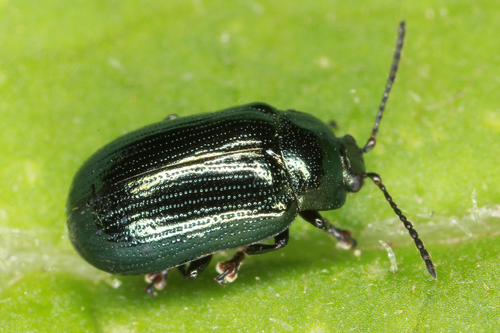
Phratora laticollis is a small beetle, measuring between 3.7 and 5 mm in body length. It shares similar size and coloration with other species in the Phratora genus; adult individuals are typically metallic blue or green. In Europe, this species most often occurs together on Populus host plants with two other Phratora species: Phratora vitellinae and Phratora atrovirens. It is larger and more abundant than P. atrovirens, and has a somewhat narrower body shape than P. vitellinae. This beetle typically lays its eggs in clutches of 8 to 16, arranged in rows on the underside of its host plant's leaves. Like other Phratora species, the eggs are partially covered with a crusty secretion. In their early instar (molting) stages, larvae feed in groups, and they sometimes exhibit color polymorphisms. Phratora laticollis has a widespread distribution. In Europe, it can be found in Arctic regions and the Nordic countries, the United Kingdom, the area extending from Germany to Spain, Serbia and Bosnia, and Bulgaria. It is also present in China and other parts of Asia. Populations of this species occur at high elevations in parts of central Europe and China. Adult Phratora laticollis feed and lay eggs on Populus trees, including Populus tremula, Populus nigra, and Populus alba. Larvae of this species develop on the same host plants that adults use. These host plants belong to the family Salicaceae. Unlike the willow species (Salix) that other Phratora species prefer, all Populus species have relatively high levels of salicylates in their leaves. Laboratory feeding tests have found that the phenol glycosides (salicylates) that are characteristic of Populus species stimulate feeding by P. laticollis. This beetle is also attracted to volatile compounds released by host trees, which may explain its preferences related to host plant gender and prior insect herbivory history of the host.