About Phragmatobia fuliginosa (Linnaeus, 1758)
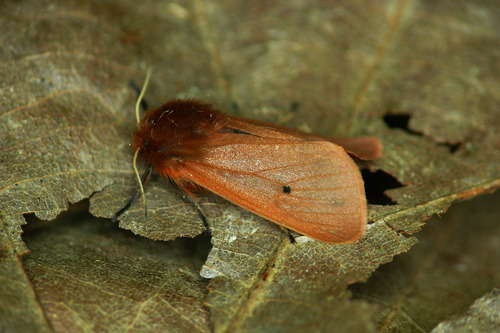
Phragmatobia fuliginosa (the ruby tiger) has a wingspan of 35–45 mm. Its thorax and forewings are dark reddish brown, with a blackish comma-shaped spot at the apex of the cell, edged with carmine. Hindwings are carmine, more or less hyaline in the costal area, with more or less confluent black spots before the margin and at the apex of the cell. The name-typical form Phragmatobia fuliginosa L. has rather densely scaled forewings, bright rose-red hindwings with distinct black spots, and an underside strongly suffused with purple-pink. Eggs are reddish grey. Larvae are light or dark grey with a black-brown head, and the entire body is covered in foxy red hairs. In the subspecies placida, these hairs are always black-brown; they may also be black-brown in typical P. fuliginosa. Pupae are black, with yellow markings on the abdomen at the segmental incisions. P. fuliginosa is distributed across the Palearctic realm. It is present across most of Europe, as well as in North Africa, Russia, Central Asia, Tibet, and northern areas of North America. This species inhabits moist open forests, meadows, low-elevation mixed hardwood forests, open meadows or prairies, and low-elevation agricultural areas. It is commonly found on low-growing plants, along highways, on railway embankments, and in waste fields. On warm winter days, larvae sometimes leave their hiding places and can be found running quickly along fieldpaths and roads.