About Phragmatobia assimilans Walker, 1855
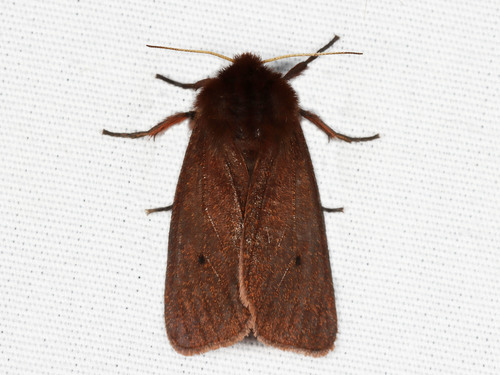
Phragmatobia assimilans, commonly known as the large ruby tiger moth, is a moth species that belongs to the family Erebidae. It was first described by Francis Walker in 1855. This moth is found in North America, ranging from Nova Scotia to Connecticut in the eastern portion of its range, extending west to British Columbia. Isolated populations also exist in northern Colorado and the Black Hills of South Dakota. Its preferred habitat includes open meadows and moist forests. The forewings of this moth measure 14 to 19 mm in length. The forewings are a dusty medium to dark orange brown, marked with dark grey antemedial and postmedial lines, plus a dark grey discal spot. The hindwings are pinkish red, with a black marginal band and dark veins. Females are typically larger and darker than males, with more developed forewing patterning. Adults have one generation per year, and are active on the wing from late spring through August. The larvae feed on a variety of herbaceous plants and low, woody hardwood shrubs.