About Photinia serratifolia (Desf.) Kalkman
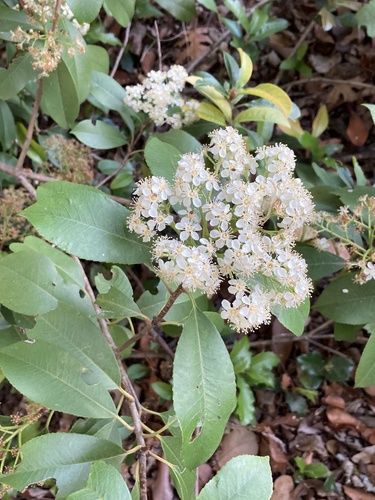
Photinia serratifolia is an evergreen tree. It reaches a typical height of 4–6 m (13–20 ft), and may occasionally grow as tall as 12 m (39 ft). In spring, this tree produces white flowers alongside new red leaves, and it develops red fruits by autumn. Its spring-blooming flowers typically last for one to two weeks, and have a strong scent widely noted to be similar to the scent of human semen. Each flower has bell-shaped sepals divided into five lobes, around 20 stamens, and an ovary with two to four locules, holding one ovule per locule. Its leaves are toxic because they contain cyanogenic glycosides. This tree produces a large number of small, bright red pomes as fruits, with diameters ranging from 4–12 millimetres (0.16–0.47 inches). Each fruit holds one to four seeds. Fruits ripen in autumn and remain on the tree through winter, serving as a food source for multiple bird species including thrushes, waxwings, and starlings. Its seeds are primarily dispersed through bird droppings. Photinia serratifolia grows at altitudes ranging from sea level up to 2,500 metres (8,000 ft). It naturally occurs in mixed forests in central and southern China, Taiwan, Japan, the Philippines, Indonesia, and India. It is widely used as a landscaping greening plant in some cities of mainland China, because it is relatively easy to plant and maintain and has low environmental requirements. In Wuhan, China, where the species is native, it is planted along all major avenues and on the campus of Wuhan University. However, the strong semen-like scent of its spring blossoms fills the city, leading some Wuhan residents to complain that the tree should be removed and replaced with other tree species.