About Phormium colensoi Hook.f.
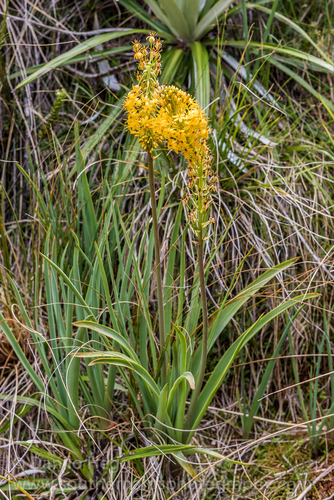
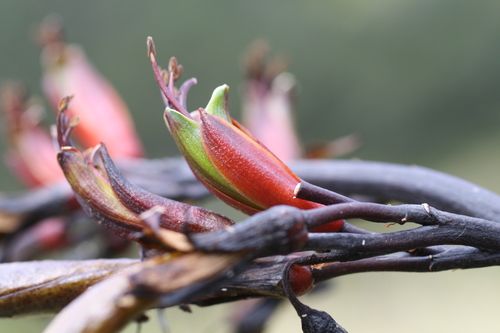
Phormium colensoi Hook.f. can be distinguished from the related Phormium tenax by several key physical traits. Its leaves are less than 2 metres long, while P. tenax leaves grow between 1 and 3 metres long. Its flowering scape is much shorter than that of P. tenax, reaching a maximum height of 2 metres, compared to around 5 metres for P. tenax. Its inner tepals are green, and its outer tepals range from yellow to red, in contrast to the dull red tepals of P. tenax. The inner tepal tips of P. colensoi are also more strongly recurved than those of P. tenax. Unlike the capsules of P. tenax, the capsules of P. colensoi are twisted and pendulous, and may be up to twice as long, reaching a maximum length of 20 cm. Each capsule holds numerous seeds that are glossy black, flat, elongated, and have a frilled margin. Phormium colensoi has two distinct geographic forms: one grows in lowland areas of New Zealand’s North Island, and the other grows in southern and mountainous regions of the South Island, as well as on ranges in the North Island. The lowland form has green or yellow tepals, while the mountain form has red tepals. Both forms and intermediate individuals can be found in the Cook Strait area. Commonly called wharariki, Phormium colensoi is a taonga, or sacred treasure, species to Māori, and many traditional cultivars have been used for different purposes. For more information on Māori use of this species, refer to Ngā Tipu Whakaoranga, the Māori Plant Use Database, its included citations, and Te Kohinga Harakeke o Aotearoa – the National New Zealand Flax Collection. The Urewera wharariki cultivar produces superior quality fibre that can be woven into a soft traditional Māori basket called a kete, and takes on a slight yellow colouration when dried. The Whakaari cultivar has leaves well-suited for weaving kete, but is less suitable than other cultivars for making piupiu, a traditional Māori flax waist-to-knees garment with a wide waistband that is used today for kapa haka performances. The leaves of the Whakaari cultivar have strong blades; they dry naturally to a deep green colour, and dry to a pale greenish-fawn after being boiled for one minute.