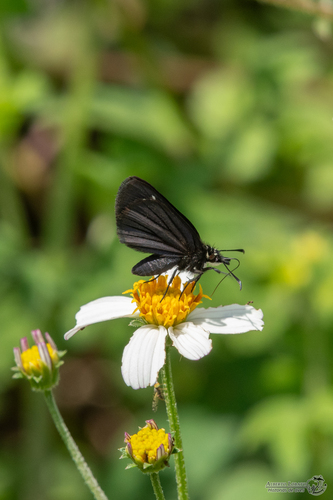
About Pholisora mejicanus (Reakirt, 1866)
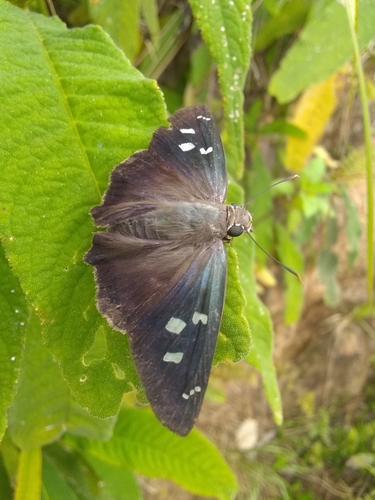
As is typical for members of the skipper butterfly family, Mexican sootywings (Pholisora mejicanus) are commonly observed moving quickly in short "skipping" bursts from place to place. Their rapid, darting flight pattern is well suited to their stout bodies, which are small to medium-sized when compared to other butterfly species. They have relatively broad heads, with widely spaced eyes and antennae. Their antennae have a distinctive hooked or recurved tip. Unlike moths, which rest with their wings spread flat, and unlike most other butterflies, which rest with their wings folded directly above their bodies, many skipper species including the Mexican sootywing rest with their wings held at different angles. When observed from above in the field, Mexican sootywings are black skippers with white dots arranged in a unique pattern. When viewed from the side, the underside of the hindwing is blue-gray with contrasting black veins. To tell Mexican sootywings apart from other species in the genus Pholisora, the dot pattern on the upper surfaces of the wings is less useful than noting the blue-gray underside of the hindwing with contrasting black veins. Comparisons between species of the genus Pholisora can be viewed on the iNaturalist page map for Pholisora mejicanus. Mexican sootywings prefer open habitats, including disturbed roadsides, railway corridors, mountainous gulches, and canyons. In the United States, Pholisora mejicanus is apparently restricted to the eastern foothills of the Rocky Mountains, ranging from southern Colorado south into Mexico. In Mexico, the species occurs from the southern border of western Texas south through the highlands to Oaxaca state in southern Mexico. The full distribution range of Pholisora mejicanus can be viewed on the iNaturalist species page for this taxon. Much of the Mexican sootywing's distribution overlaps with that of the more common and visually similar common sootywing, Pholisora catullus. In New Mexico, even though the two species occupy the same general area, they rarely occur in the same location. When they do occur together, they do not interbreed. Their larvae can even be found on the same host plant. Genetic studies confirm that the two species have remained evolutionarily independent for a long time, though it is still unclear how this separation is maintained.