About Pholiota squarrosoides (Peck) Sacc.
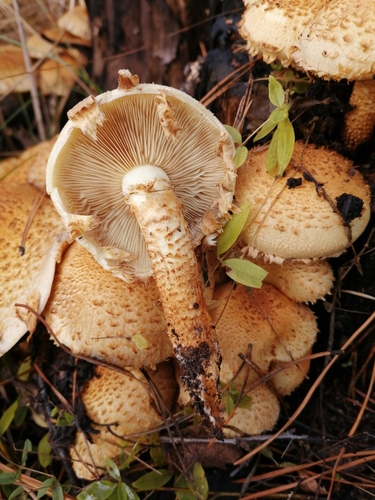
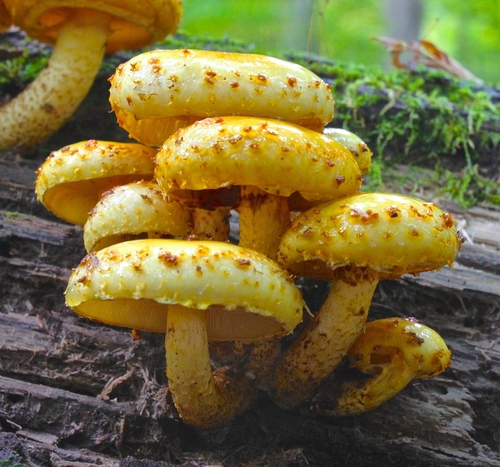
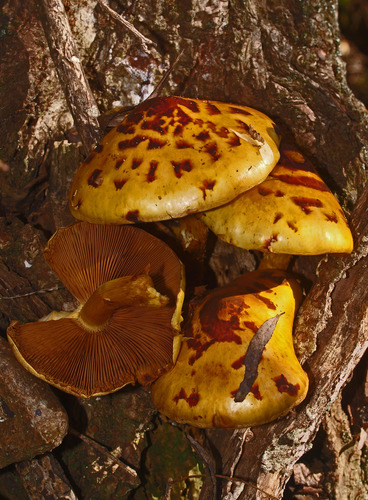
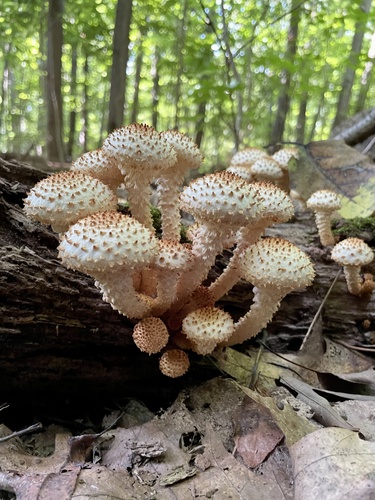
Pholiota squarrosoides (Peck) Sacc. grows in crowded clusters. Its caps reach up to 10 cm (4 in) in diameter, and stems reach up to 14 cm (5.5 in) in length. Caps are convex when young, become flattened as they age, and are sticky when wet. They are yellowish-brown, covered in prominent, crowded, cone-shaped tawny scales that are concentrated near the cap center. The gills are closely packed; they start yellow and turn rusty-brown as the mushroom matures. The stem matches the cap in color and is covered in small scales. Near the top of the stem, there is a cottony, yellowish, flared ring. The spores are brown, and they produce a rusty brown spore print. This species is commonly found in late summer in the Great Lakes states, the Pacific Northwest, and eastern North America, growing on the bark of hardwood trees. It is rarely found in Europe; the first known specimen from Poland was discovered in 2010 in southwestern Poland, at the Łężczok Nature Reserve near the town of Racibórz. It may also occur in the temperate regions of Asia. Although Pholiota squarrosoides is classified as a saprophyte rather than a parasite, it can cause wood to degrade rapidly. In the Great Lakes region, it decays logs of Acer saccharum and Tilia glabra.