About Pholiota squarrosa (Vahl) P.Kumm.
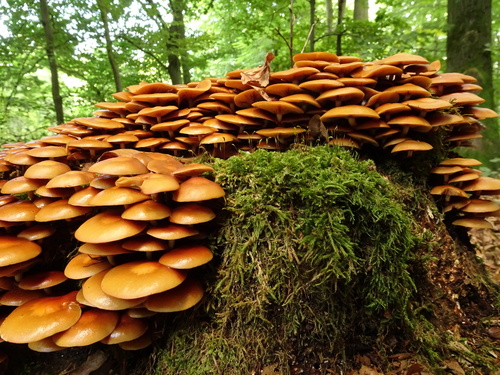
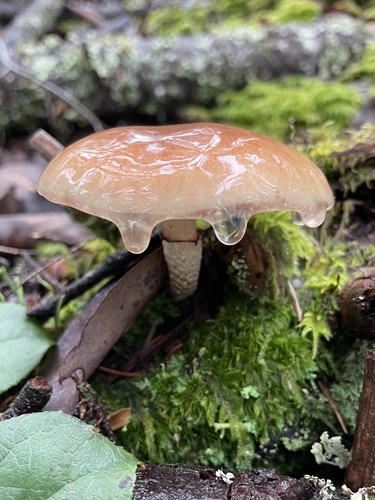
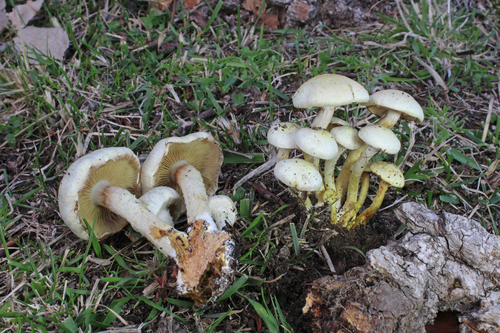
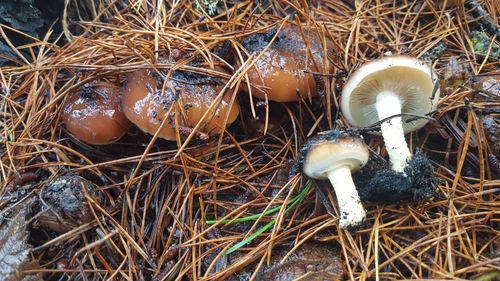
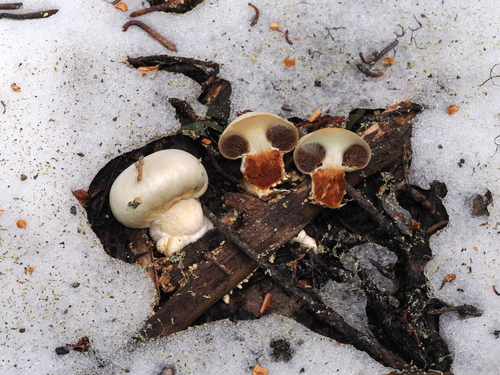
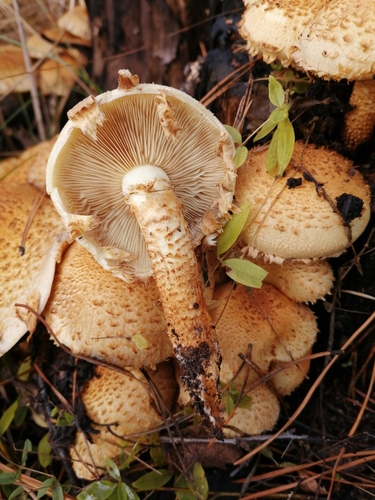
Like other mushrooms in the Pholiota genus, Pholiota squarrosa has a scaly cap and stem. The cap of P. squarrosa ranges from 3 to 12 cm (1.2 to 4.7 in) in diameter. Depending on age, its shape changes from bell-shaped to rounded to somewhat flattened. In older specimens, the cap color is yellowish-brown to tawny. The scales on the cap are yellowish to tawny and recurved. The stem measures 4 to 12 cm (1.6 to 4.7 in) long by 0.5 to 1.5 cm (0.20 to 0.59 in) thick, and is roughly equal in width along its entire length. The partial veil, which covers the gills when young, develops into a thick, woolly ring on the upper part of the stem. The stem is bare above the ring, and scaly like the cap below the ring. When young, the gills are covered by a partial veil and have a greenish-brown color; mature gills turn rusty brown. The gills are crowded closely together, attached to the stem (adnate), and usually notched (sinuate). The spore print of P. squarrosa is cinnamon or rusty brown. Its spores are elliptic, smooth-walled, and nonamyloid, meaning they do not absorb iodine when stained with Melzer's reagent. Spores measure 6.6–8 by 3.7–4.4 μm. The spore-bearing cells, called basidia, are club-shaped, four-spored, and measure 16–25 by 5–7 μm. The odor of P. squarrosa fruit bodies has been described as resembling garlic, radish, lemon, onion, or skunk, and the taste matches that of radish. Pholiota squarrosa typically grows in clusters at the base of trees and stumps. P. squarrosa is thought to be a white rot fungus. White rot fungi use cellulose as a carbon source, and can degrade the lignin found in wood into carbon dioxide to access the cellulose molecule. This fungus can attack a wide variety of deciduous host trees, including sugar maple, red maple, yellow birch, paper birch, American beech, and white ash. It can also attack conifers such as spruce. It is a secondary parasite, meaning it only attacks trees that have already been weakened by prior injury or infection by bacteria or other fungi. It also acts as a saprobe, and can obtain nutrients by breaking down organic matter in dead wood. P. squarrosa is found in North America and Europe. In North America, its distribution extends north to Canada and south to Mexico, where it only grows in coniferous forests. In the Netherlands, P. squarrosa is one of many mushroom species that regularly fruit on ancient timber wharves. The fruit bodies of P. squarrosa are a primary food source for the red squirrel Sciurus vulgaris, and they have a higher protein content than the other mushrooms that this species typically consumes. Decaying P. squarrosa fruit bodies also serve as a food source for fruit flies of the genus Drosophila.