About Pholiota nubigena (Harkn.) Redhead
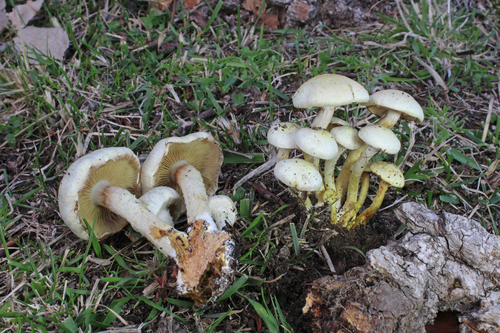
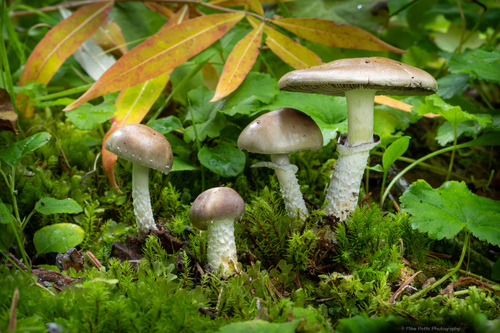
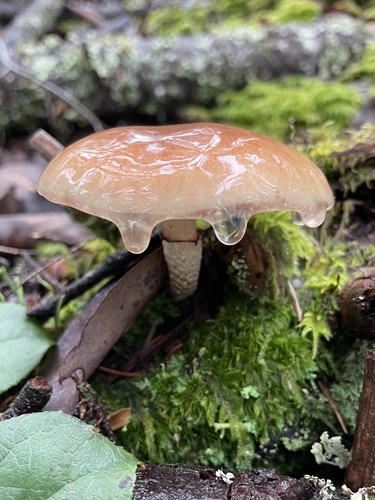
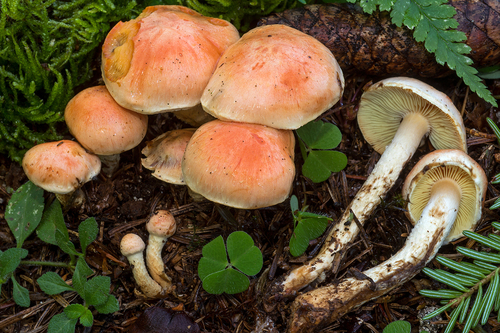
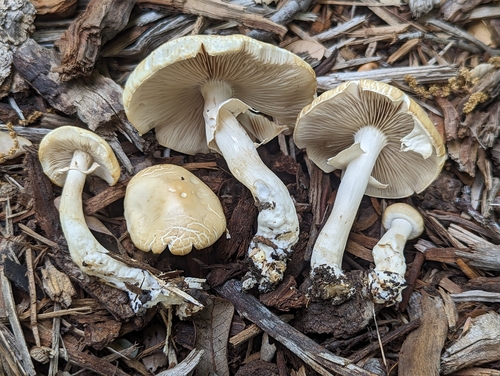
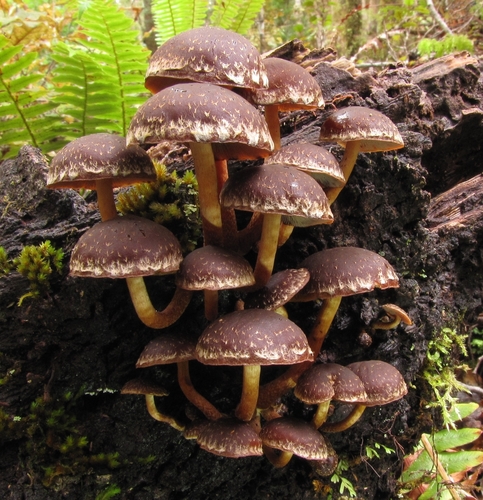
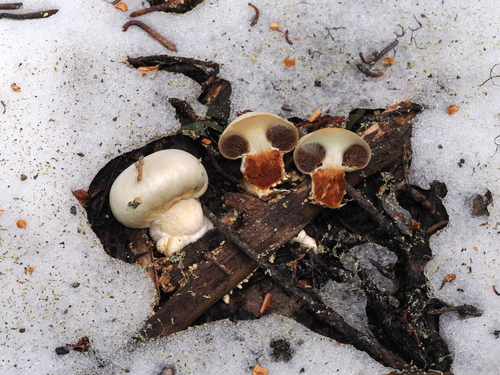
Fruit bodies of Pholiota nubigena are 1.5–4 cm (5⁄8–1+5⁄8 in) tall, with round to convex caps 1–2.4 cm (3⁄8–1 in) in diameter. Mature caps develop a flattened or depressed center. Cap color ranges from ochre to tawny, dirty yellow, or whitish (especially in older specimens), with a surface texture that is smooth to slightly fibrillose. Caps are somewhat sticky when wet. Young specimens have inward-curving, often lobed cap margins; as the mushroom matures, the margin may pull away from the stipe or remain attached. The short, stout stipe measures 0.5–2 cm (1⁄4–3⁄4 in) long by 0.2–2 cm (1⁄8–3⁄4 in) thick, and extends into the cap where it is called the "columella". The stipe is roughly equal in width along its length, or thicker at either end, and colored whitish to brownish to rusty-brown. Cap flesh is white and soft, while stipe flesh is brownish and tougher. The odor ranges from mild to distinctly fruity, like bubble gum. Mature gills are brown to cinnamon brown, arranged as irregular, deformed plates that form internal chambers called locules. Gills may not become exposed until maturity, if at all. The partial veil, which appears as whitish cottony tissue stretching from the cap margin to the stipe, often disappears as the mushroom ages. The edibility of this fungus is unknown. Fruit body development of Pholiota nubigena is classified as "pileate", meaning it has a single stalk with gleba arranged into gill-like trymal plates; Podaxis species share this type of development. The smooth, thick-walled elliptical spores are typically 7.5–10 by 5–7 μm, with a narrow germ pore. This mushroom does not produce a spore print, but spores are yellow-brown in mass. The spore-bearing basidia are hyaline (translucent) and club-shaped. Most are four-spored, though some are two-spored, and they measure 17–21 by 6–8.2 μm. Pseudoparaphyses, cells that grow downward from the roof of locules and often connect the locule roof and floor, are abundant in the gleba, and measure about 16 by 12.5 μm. Cystidia are yellowish to brownish with thin walls, and measure 60–100 by 15–25 μm. The peridium has two distinct tissue layers. The outer epicutis is a 15–50 μm layer made of narrow, gelatinous interwoven hyphae. Beneath the epicutis is the subcutis, which consists of thin-walled hyphae up to 12 μm in diameter. All hyphae are inamyloid, and all have clamp connections. Pholiota nubigena fruits singly, in groups, or small clusters on rotting conifer wood, especially fir and lodgepole pine. It fruits in spring and early summer, and is a snowbank fungus, meaning it is often found near melting snow or shortly after snow disappears. In the United States, it is common in the Sierra Nevada and Cascade Mountains, typically found at elevations between 1,650 and 2,400 m (5,410 to 7,870 ft). It has been collected from the US states of California, Idaho, Oregon, and Washington. Squirrels eat this fungus, and sometimes collect fruit bodies and leave them in sunny spots to dry for later use.