About Pholiota adiposa (Batsch) P.Kumm.
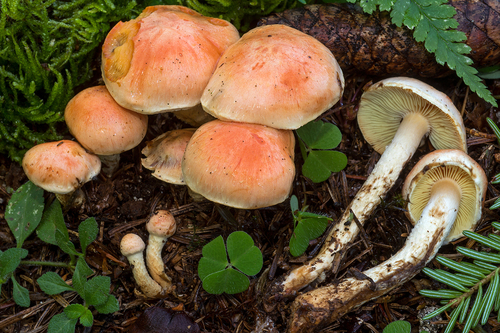
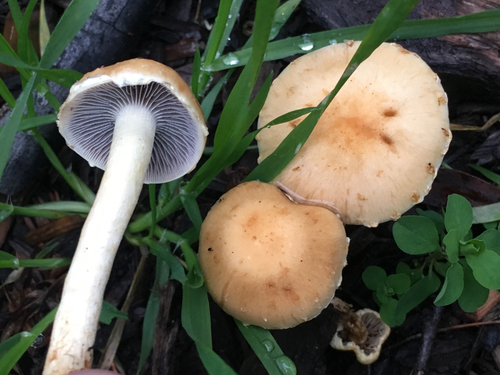
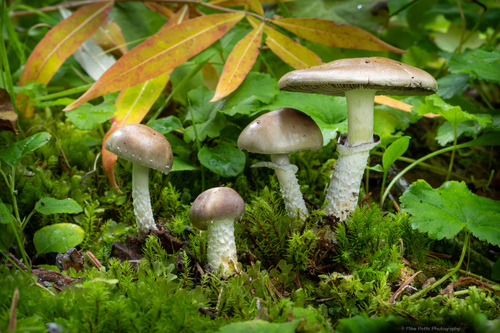
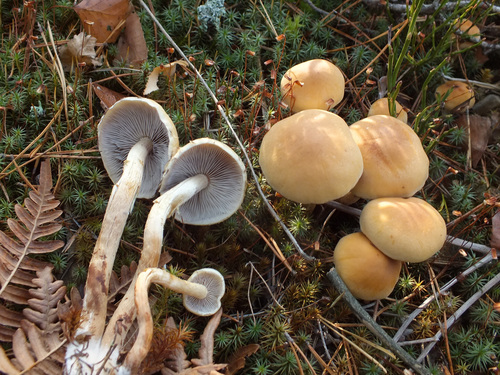
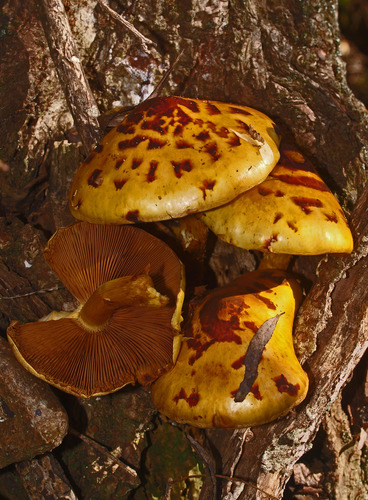
This fungus has the scientific name Pholiota adiposa (Batsch) P.Kumm. Its fruiting bodies are fasciculate, meaning they grow in dense bunches. The cap can reach up to 9.5 centimetres (3+3⁄4 inches) wide, and ranges in color from yellow to orangish, with dark scales arranged in concentric patterns. The gills are crowded, and colored yellow to brown. The stipe can grow up to 12 cm (4+3⁄4 inches) long, is cylindrical, and widens slightly at its base. The spore print of this species is brown. Spores are ovoid to ellipsoid, smooth, brown, and measure approximately 7.5–9.5 x 5–6.3 μm. Spores are produced on cylindrical or clavate basidia that typically have 4 sterigmata, though 2–3 sterigmata may occur occasionally. P. adiposa produces two types of cystidia: chrysocystidia that measure 25–56 x 7.5–11 μm, and cheilocystidia that measure 20–50 x 5–17 μm. Its cheilocystidia can take fusiform, cylindrical, clavate, lageniform, or obovoid shapes. All tissues of this fungus have clamp connections. P. adiposa has been recorded in North America, Europe, and Asia. It grows either parasitically on living tree stems, or as a saprotroph on dead wood. Known substrate trees include various species of beech, poplar, and willow. Fruiting occurs between August and November, and is most common between September and October. Unlike fungi that grow on buried wood, P. adiposa fruiting bodies grow above ground. Mycelial growth occurs between 10 and 30 °C, with an optimal growth temperature of 25 °C. Growth is severely inhibited when temperatures are below 5 °C or above 35 °C. When grown in growth media, P. adiposa can survive in a pH range of 5 to 9, and grows best at pH 6.