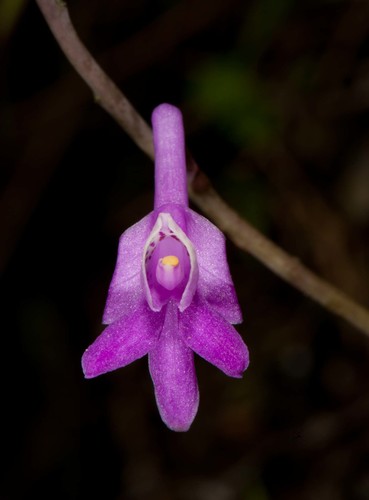
About Pholidota imbricata Lindl.
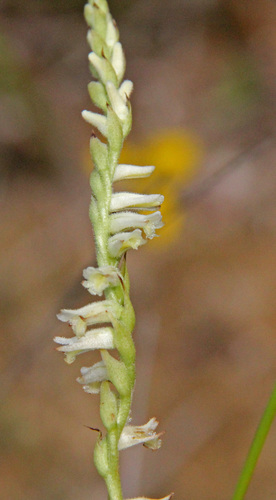
Pholidota imbricata Lindl. (previously described as Coelogyne imbricata), commonly known as the common rattlesnake orchid, is an epiphytic or lithophytic clump-forming herb. It has crowded pseudobulbs that measure 80–120 mm (3.1–4.7 in) long and 30–50 mm (1.2–2.0 in) wide. Each pseudobulb bears one pleated, leathery, dark green leaf that is oblong to lance-shaped, 200–400 mm (7.9–16 in) long and 60–80 mm (2.4–3.1 in) wide, carried on a stalk about 50 mm (2.0 in) long. Between twenty and sixty resupinate, cup-shaped flowers grow arranged in two rows along a wiry flowering stem 150–400 mm (5.9–16 in) long. Flowers can be white, cream-coloured or greenish, and measure 6–8 mm (0.24–0.31 in) long and 5–7 mm (0.20–0.28 in) wide. Each flower has a large, concave pinkish bract at its base. The dorsal sepal is 4–5 mm (0.16–0.20 in) long and 3–4 mm (0.12–0.16 in) wide, while the lateral sepals are 6–7 mm (0.24–0.28 in) long and about 3 mm (0.12 in) wide. Petals are 3–4 mm (0.12–0.16 in) long and about 1.5 mm (0.059 in) wide. The labellum is about 4 mm (0.16 in) long and 5 mm (0.20 in) wide, concave with three lobes; its side lobes are erect, and the midlobe is further divided into three lobes. This species flowers between March and May. The common rattlesnake orchid most often grows on trees and rocks in rainforest, and sometimes grows in other humid, sheltered locations. Its distribution spans China, the Indian subcontinent, Cambodia, Laos, Myanmar, the Nicobar Islands, Thailand, Vietnam, Borneo, Java, the Lesser Sunda Islands, Peninsular Malaysia, the Maluku Islands, the Philippines, Sulawesi, Sumatra, the Bismarck Archipelago, New Guinea, the Solomon Islands, Queensland, Fiji, New Caledonia, the Santa Cruz Islands and Vanuatu. In the Australian state of Queensland, it occurs on some Torres Strait Islands and on Cape York Peninsula, ranging as far south as Townsville.