About Phoenix roebelenii O'Brien
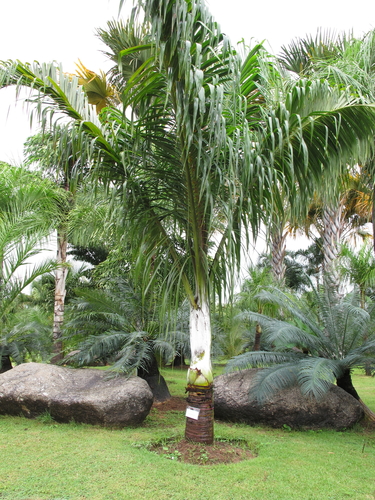
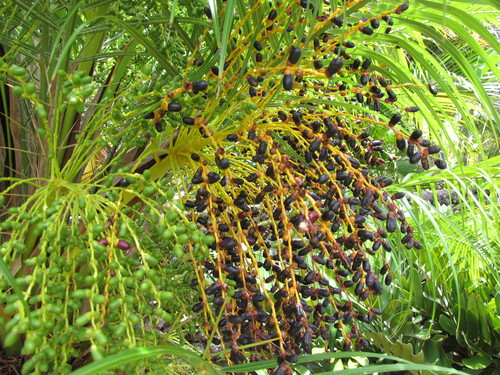
Phoenix roebelenii is a small to medium-sized, slow-growing slender tree that reaches 2–7 metres (6.6–23.0 ft) in height. Its leaves measure 60–120 cm (24–47 in) long, and are pinnate, with around 100 leaflets arranged in a single plane — this differs from the related species P. loureiroi, whose leaflets are arranged in two planes. Each individual leaflet is 15–25 cm (6–10 in) long and 1 cm wide, slightly drooping, and grey-green, with scurfy pubescence on its underside. The plant produces small, yellowish flowers on an inflorescence that grows to 45 cm (18 in) long. Its fruit is an edible 1 cm drupe that resembles a small, thin-fleshed date.
As an ornamental plant, Phoenix roebelenii is popularly grown in gardens located in tropical and subtropical climates. Because it requires a minimum temperature of −3 °C (27 °F), it is grown under glass or as a houseplant in cooler regions. It needs only minimal pruning to develop a strong structure, is resistant to pests, tolerates a wide range of soil types, and has moderate drought tolerance. It can grow in partial shade to full sun, with the appropriate planting position determined by the local climate. This plant has received the Royal Horticultural Society's Award of Garden Merit. The NASA Clean Air Study found that Phoenix roebelenii is effective at removing the common household air toxins formaldehyde and benzene.