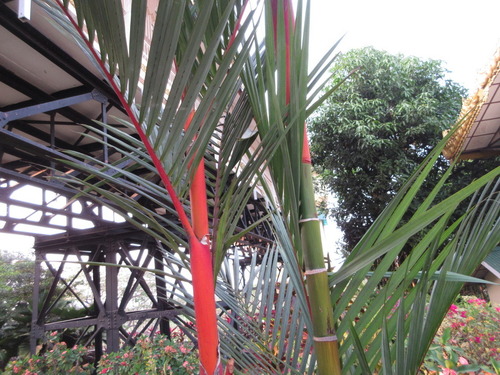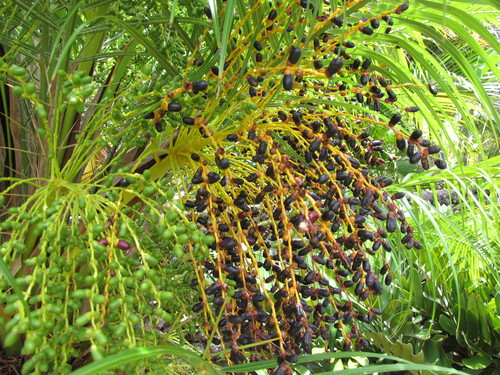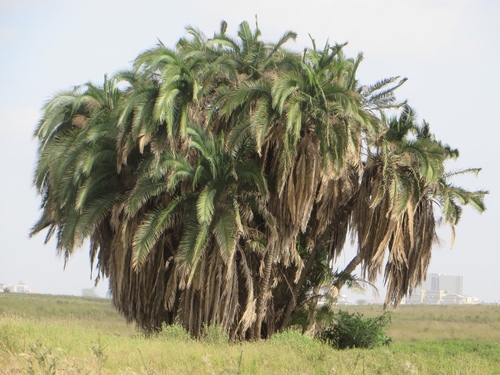
About Phoenix reclinata Jacq.
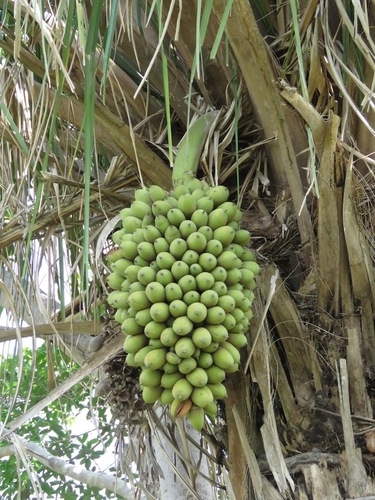
Phoenix reclinata Jacq. is a dioecious clumping palm that produces multiple stems ranging from 7.5 to 15 m (25 to 49 ft) in height and up to 30 cm (12 in) in width. Its foliage is pinnate and recurved, growing 2.5 to 4.5 m (8.2 to 15 ft) long and 0.75 m (2 ft 6 in) wide. Leaves range in color from bright to deep green, growing on 30 cm petioles that have long, sharp spines at the base. Each crown holds 20 to 40 leaves. As a unisexual species, florets form at the top of the palm stem. Male florets are a dull pale yellow and fall away after blooming, while female florets are small, globose and yellow-green. This species bears edible, oblong orange fruit that reaches 2.5 cm (1 in) in diameter when ripe. The fruit grows in large, pendant clusters, with each fruit containing a single seed. All palms in the genus Phoenix hybridize freely with one another, producing natural variations in the species. These palms generally tolerate salt spray and moderate drought when the water table stays permanently high. In addition to its edible fruit, which attracts animals including humans, its palm heart can be eaten as a vegetable. In KwaZulu-Natal and Botswana’s Okavango Delta, palm sap is tapped shortly before flowering to make palm wine. Fibre from young, unopened leaves can be used to make carpets, kilts and brooms. Its roots contain tannin and can be used to make a brown dye, and also produce an edible gum. The palm’s lightweight wood is not particularly useful.