About Phoenix dactylifera L.
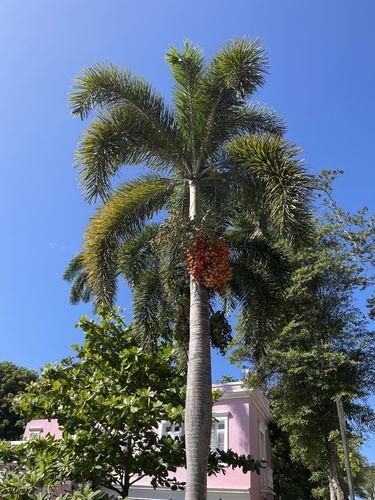
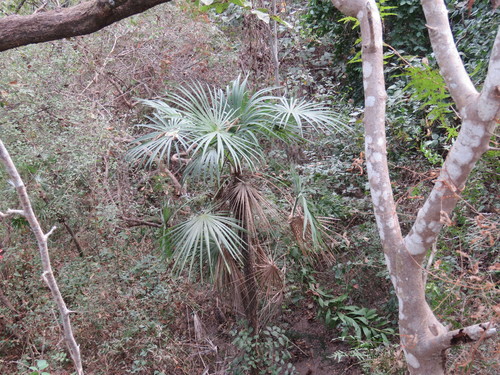
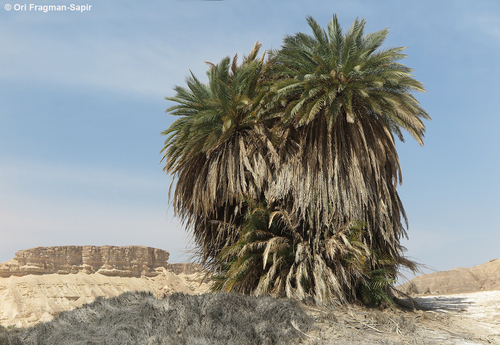
Phoenix dactylifera L., commonly known as the date palm, can reach up to 30 metres (100 feet) in height. It grows either singly or forms a clump with multiple stems growing from a single root system. Date palms grow best in areas with an average temperature range of 12.7 to 27.5 °C, and are slow-growing. When properly maintained, they can live for over 100 years. Their roots have structures called pneumatodes. Mature leaves are 4–6 m (13–20 ft) long, with spines along the petiole, and are pinnate with around 150 leaflets. Each leaflet measures 30 centimetres (12 inches) long and 2 cm (1 in) wide. The full span of the tree's crown ranges from 6–10 m (20–33 ft). The date palm is dioecious, meaning it has separate male and female individual plants. Like all species in the genus Phoenix, date palm sex is determined through an XY sex-determination system; three genes have been identified that are conserved in all male plants and absent from all female plants. Date palms can be easily grown from seed, but only 50% of seedlings will be female and therefore able to produce fruit. Dates harvested from seed-grown plants are often smaller and of poorer quality. Most commercial date palm plantations therefore use cuttings taken from heavily cropping cultivars. Plants grown from cuttings begin producing fruit 2–3 years earlier than plants grown from seed. In nature, dates are pollinated by wind. However, in both traditional oasis horticulture and modern commercial date orchards, all date palm pollination is done by hand. In natural, unassisted pollination, populations of date palms have roughly an equal number of male and female plants. With human-assisted pollination, a single male date palm can pollinate up to 100 female plants. Since male date palms are only valued for their use as pollinators, they are usually pruned away to make more space for fruit-producing female plants. Some growers do not keep any male plants at all, because male flowers can be purchased at local markets during the pollination season. Manual pollination is carried out by skilled labourers working on ladders, or with the use of a wind machine. In some regions such as Iraq, pollinators climb the tree using a special climbing tool that wraps around the tree trunk and the climber's back, called تبلية in Arabic, to keep the climber attached to the trunk while ascending. Ripe date fruits are oval-cylindrical, measuring 3–7 cm (1–3 in) in length and 2–3 cm (3⁄4–1+1⁄4 in) in diameter. When ripe, their colour ranges from bright red to bright yellow, depending on the cultivar. Dates contain a single hard stone (seed) that is about 2–2.5 cm (3⁄4–1 in) long and 6–8 mm (1⁄4–5⁄16 in) thick. There are three main groups of date palm cultivars: soft cultivars such as Medjool, semi-dry cultivars such as Deglet Nour, and dry cultivars such as Thoory. The place of origin of the date palm is uncertain, due to its extremely long history of cultivation. Some sources indicate it probably originated in the Fertile Crescent region that spans Egypt and Mesopotamia, while other sources state that date palms are native to the Persian Gulf area, or that they are derived from wild date palms native to western India. Fossil records show that date palms have existed for at least 50 million years. A major palm pest, the red palm weevil (Rhynchophorus ferrugineus), currently poses a significant threat to date production in parts of the Middle East, as well as to iconic landscape date palm specimens across the Mediterranean world. Another significant insect pest is Ommatissus lybicus, sometimes called the "dubas bug"; sap sucking by this pest leads to the formation of sooty mould on date palms. In the 1920s, eleven healthy Medjool date palms were moved from Morocco to the United States, where they were cared for by members of the Chemehuevi tribe in a remote region of Nevada. Nine of the eleven palms survived, and in 1935, cultivars derived from these palms were transferred to the U.S. Date Garden in Indio, California. Eventually, this Medjool stock was reintroduced to Africa, and it led to the establishment of commercial date production in the United States in Yuma, Arizona, and Bard, California. Dates are a traditional crop cultivated across the Middle East and North Africa. Dates, especially the Medjool and Deglet Nour cultivars, are also cultivated in the southwestern United States, and in Sonora and Baja California in Mexico. After planting, date palms can take 4 to 8 years before they will bear any fruit, and begin producing viable yields for commercial harvest between 7 and 10 years after planting. A mature date palm can produce 70–140 kilograms (150–300 pounds) of dates per harvest season. Date fruits do not all ripen at the same time, so multiple harvests are required over the season. To get fruit that meets marketable quality standards, bunches of developing dates must be thinned and bagged or covered before they ripen. This process allows the remaining fruits to grow larger, and protects them from weather and animals such as birds that feed on dates. Date palms require well-drained, deep sandy loam soils with a pH of 8–11, which is alkaline. The soil must be able to hold moisture, and must also be free of calcium carbonate.