About Phoenicurus ochruros (S.G.Gmelin, 1774)
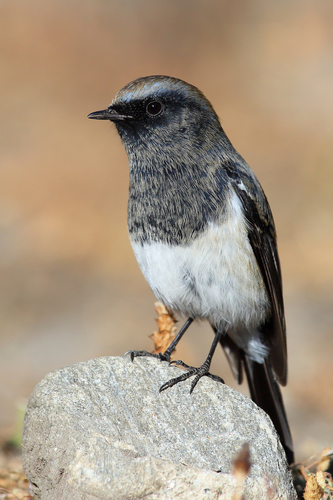
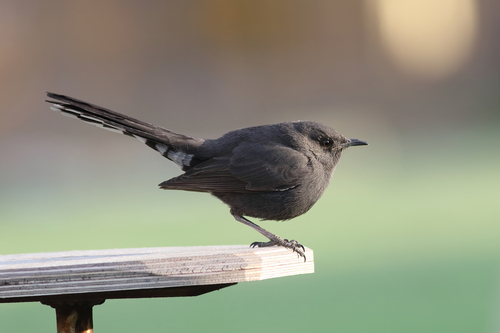
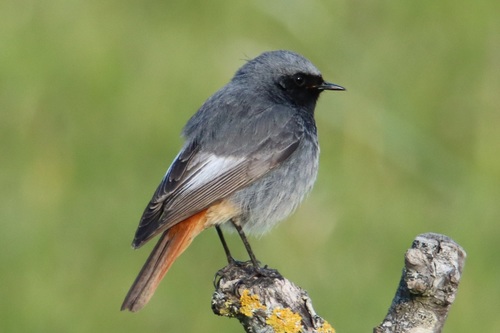
This species, commonly called the black redstart, has a scientific name of Phoenicurus ochruros (S.G.Gmelin, 1774). It measures 13–14.5 cm (5.1–5.7 in) in length and weighs 12–20 g (0.42–0.71 oz), which is similar in size to the common redstart. Adult males have dark grey to black upperparts and a black breast, with orange-red lower rumps and tails. The two central tail feathers are dark red-brown. The color of the belly and undertail differs by subspecies: they are blackish-grey in western subspecies, and orange-red in eastern subspecies. Wing color also differs between subspecies: western subspecies have blackish-grey wings with pale fringes on the secondaries that form a whitish panel, while eastern subspecies have entirely blackish wings. Females are overall grey in western subspecies, and grey-brown in eastern subspecies; they only share the orange-red lower rump and tail with males. Females are greyer than common redstarts. At any age, black redstarts can be distinguished from common redstarts by their grey axillaries and underwing coverts; common redstarts have buff to orange-red axillaries and underwing coverts. For first calendar year males, at least in western subspecies, there are two distinct forms. The first form, called 'carei', is similar in appearance to females. The second form, called 'paradoxus', looks similar to an adult male but lacks the whitish wing panel, which only develops during the post-breeding wing feather moult that occurs in the second calendar year. The 'paradoxus' form is much rarer than the 'carei' form. The black redstart is a widespread breeding species across south and central Europe, Asia, and north-west Africa. Its breeding range extends from Great Britain and Ireland, where it occurs only locally, south to Morocco, and east to central China. Birds in the milder parts of this range are resident, while birds from the north-eastern portion of the range migrate to winter in southern and western Europe, southern and western Asia, and north Africa. Black redstarts build their nests in crevices or holes in buildings. In Britain, the species is most common as a passage and winter visitor, with only 20–50 breeding pairs. It is fairly common along the east and south coasts during migration. In winter, it occurs mainly on the coasts of Wales and western and southern England, with a small number also found at inland sites. Migrating black redstarts arrive in Britain in October or November; they either continue moving further south or stay to winter in Britain, and return eastward in March or April. They also winter on the south and east coasts of Ireland. Black redstarts originally lived on stony ground in mountains, especially cliffs. Starting around 1900, it has expanded its range to include similar urban habitats, including bombed areas during and after World War II, and large industrial complexes that provide the bare areas and cliff-like buildings the species favors. In Great Britain, most of the small local breeding population nests in these kinds of industrial areas. Black redstarts catch passing insects in flight, and migrating individuals often hunt in coastal tide-wrack for flies or tiny crustaceans. Their quick head and body dips are similar to the movement of a robin, and they often flick their tails. Males have a rattling song and a tick call. Birds of the eastern race are very rare vagrants in western Europe.