About Phoenicurus erythronotus (Eversmann, 1841)
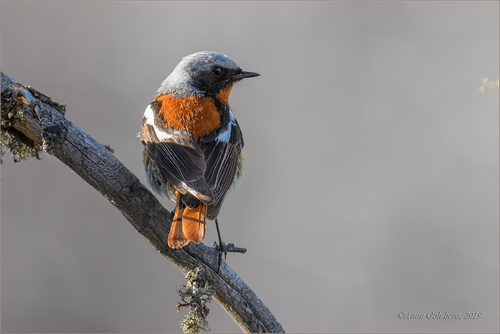
Phoenicurus erythronotus is one of the larger redstart species, measuring 15 to 16 cm (5.9 to 6.3 in) in length, with a wingspan of 25.5 to 27 cm (10.0 to 10.6 in), and a body weight of 15 to 22 g (0.53 to 0.78 oz). This species has black bills and legs. Breeding plumage males have a black mask, grey crown and nape, rufous back and rump, and a rufous tail with darker central feathers. Their wings are dark, with white patches on the scapulars and primary-coverts; their underparts are mostly rufous, with white coloring on the belly and undertail-coverts. Non-breeding and first-winter males are similar in pattern, but much duller and browner in tone. Females are mostly grey-brown, with a rufous tail that has a dark center, a pale eye-ring, two buff wingbars, and buff edges along the tertials. The song of this species is loud and lively. Birds also produce a soft, croaking call and a whistling call. Their tails are often flicked up and down. This species breeds in the mountains of Central Asia and southern Siberia, ranging from the Tien Shan range to the Tarbagatay and Altay Mountains, and extending to areas near Lake Baikal. Some individuals move downhill to spend the winter, while others, particularly those in the northeastern part of the breeding range, migrate longer distances. Its wintering range stretches from southern Iraq, through Iran and Pakistan, to the western Himalayas of Kashmir. A small number of individuals reach eastern Arabia. It has been recorded as a vagrant in Israel and Turkey. During the breeding season, it inhabits forest and woodland, and can be found up to 5,400 meters above sea level. In winter, it occurs in more open and arid habitats.