About Phoenicurus auroreus (Pallas, 1776)
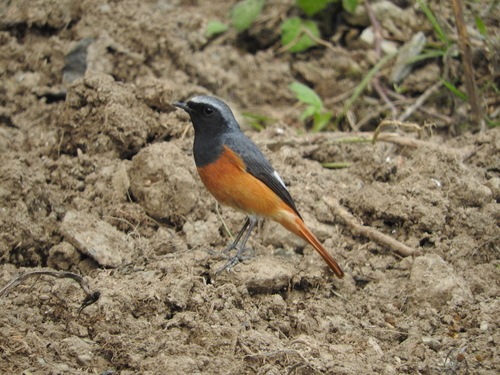
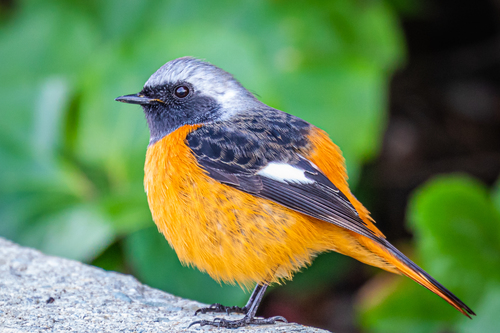
Phoenicurus auroreus (Pallas, 1776), commonly known as the Daurian redstart, measures 14 to 15 cm in length and weighs 11 to 20 grams. Like all typical redstarts, this species displays strong sexual dimorphism. Breeding males have a grey crown and nape, with a lighter forehead and lighter sides of the crown, a black face and chin, brownish mantle and wings, and a large white wing patch. Their chest, lower back, and rump are orange, while their tail is black with orange sides. Juvenile males follow a similar patterning, but their markings are much duller and less distinct. Females have warm brown upperparts and paler underparts, with an orange rump, orange tail sides, and a large white wing patch matching the one seen in males. In both sexes, the bill, eyes, legs, and feet are black. This species was historically classified as a member of the thrush family Turdidae, but it is now generally accepted as belonging to the Old World flycatcher family Muscicapidae. It is split into two subspecies: the eastern nominate subspecies P. a. auroreus, and the western subspecies P. a. leucopterus. P. auroreus belongs to a tightly related Eurasian clade of redstarts that also includes the black redstart (P. ochruros), Hodgson's redstart (P. hodgsoni), the white-winged redstart (P. erythrogastrus, which may be especially closely related to P. auroreus), and possibly the Ala Shan redstart (P. alaschanicus). All members of this clade diverged between 3 and 1.5 million years ago, during the latter part of the Late Pliocene and the earliest Early Pleistocene, when Quaternary glaciation began. This species is distributed across Manchuria, southeastern Russia, northeastern Mongolia, central China, and Korea. It is migratory: the nominate subspecies P. a. auroreus winters in Korea, Japan, southeast coastal China, and Taiwan, while P. a. leucopterus winters in northeast India and parts of Southeast Asia. Daurian redstarts prefer open forests, forest edges, and agricultural margins, and are also commonly found in parks and urban gardens. They are relatively trusting of humans, and often allow people to approach quite closely before moving away. Breeding occurs during the summer months, and a mated pair of the nominate subspecies has been observed in early May. The species is widespread and fairly common, so the IUCN does not consider it a threatened species.