About Phocoena phocoena (Linnaeus, 1758)
Scientific Naming and Size Comparison
The harbour porpoise, scientifically named Phocoena phocoena (Linnaeus, 1758), is smaller than other porpoise species.
Newborn Measurements
Newborns measure 67–85 cm (26+1⁄2–33+1⁄2 in) in length and weigh 6.4–10 kg (14–22 lb).
Adult Size and Weight
Adult individuals of both sexes reach a total length of 1.4 to 1.9 m (4 ft 7 in to 6 ft 3 in); females are heavier on average, with a maximum recorded weight of around 76 kg (168 lb) compared to 61 kg (134 lb) for males.
Body Morphology
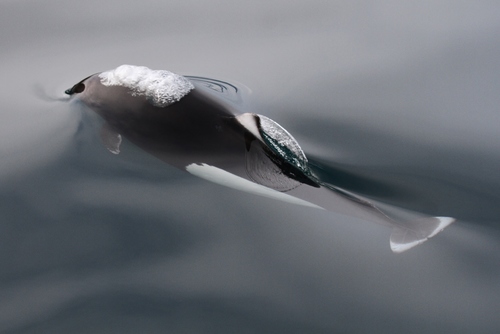
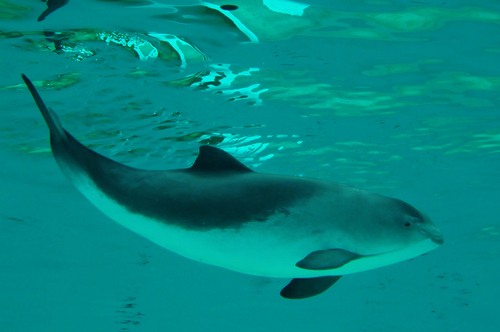
Harbour porpoises have robust bodies, with their maximum girth located just in front of their triangular dorsal fin, and a poorly demarcated beak.
External Coloration
Their flippers, dorsal fin, tail fin and back are dark grey, while their sides are a slightly speckled, lighter grey.
Their underside is much whiter, though it usually has grey stripes running along the throat from the underside of the body.
Anomalous White Individuals
Many anomalously white-coloured harbour porpoises have been confirmed, most frequently in the North Atlantic; they have also been recorded notably around Turkish and British coasts, in the Wadden Sea, the Bay of Fundy, and around the coast of Cornwall.
Conjoined Twins Record
While conjoined twins are rarely observed in wild mammals, the first documented case of a two-headed harbour porpoise was recorded in May 2017, when Dutch fishermen in the North Sea caught the pair by chance.
A study published in the online journal of the Natural History Museum Rotterdam notes that conjoined twins in whales and dolphins are extremely rare.
Vocalization Structure
The vocalizations of the harbour porpoise consist of short clicks 0.5 to 5 milliseconds long, produced in bursts up to two seconds long.
Each click has a frequency between 1000 and 2200 hertz, and these clicks are used both for communication and echolocation.
Global Distribution Range
Harbour porpoises are widespread in cooler coastal waters of the North Atlantic, North Pacific, and Black Sea.
Atlantic Distribution
In the Atlantic, they may occur in a curved band of water extending from the coast of West Africa to the coasts of Portugal, Spain, France, the United Kingdom, Ireland, Scandinavia, Iceland, Greenland, Nova Scotia, Newfoundland, and the eastern seaboard of the United States.
The Baltic Sea population is limited in winter due to sea ice, and is most common in the southwestern part of the sea.
Pacific Distribution
In the Pacific Ocean, they occur in another band running from the Sea of Japan, Vladivostok, the Bering Strait, Alaska, British Columbia, and California.
Subspecies Classification
Populations across these regions are not continuous, and are classified as separate subspecies: P. p. phocoena in the North Atlantic and West Africa, P. p. relicta in the Black Sea and Sea of Azov, an unnamed population in the northwest Pacific, and P. p. vomerina in the northeast Pacific.
2018 North Atlantic Status Workshop
In 2018, an international workshop co-organised by the North Atlantic Marine Mammal Commission and the Norwegian Institute of Marine Research reviewed the species' status in the North Atlantic.
The workshop concluded that harbour porpoise population structure is more complex than previously thought, with at least three genetically distinct subspecies in the North Atlantic.
Based on this population structure, the workshop delineated 18 assessment areas for the North Atlantic.
Habitat Preference
Harbour porpoises prefer temperate and subarctic waters, and inhabit fjords, bays, estuaries, and harbours—this habitat preference gives the species its common name.
Primary Diet
They feed mostly on small pelagic schooling fish, particularly herring, pollack, hake, sardine, cod, capelin, and sprat.
They will also eat squid and crustaceans in some locations.
Feeding Depth Habits
This species tends to feed close to the sea bottom in waters less than 200 metres (110 fathoms) deep, but may stay closer to the surface when hunting sprat.
In deeper waters, harbour porpoises may forage for mid-water fish such as pearlsides.
2016 Danish Coast Feeding Study
A 2016 published study found that harbour porpoises off the coast of Denmark hunted 200 fish per hour during the day and up to 550 fish per hour at night, catching 90% of the fish they targeted.
Almost all fish eaten were very small, between 3 and 10 cm (1–4 in) long.
2024 Black Sea Acoustic Activity Study
A 2024 study found that prey availability is an important driver of seasonal and diel dynamics of harbour porpoise acoustic activity in the Black Sea.
In the southeastern Black Sea, porpoise activity was primarily nocturnal, with a peak from January to May that aligned with anchovy migration.
On the northwestern shelf, porpoises were more active during daylight from April to October, matching the migration patterns of sprat.
Foraging Behavior
Harbour porpoises tend to be solitary foragers, but they sometimes hunt in packs to herd fish together.
Juvenile Food Requirements
Young harbour porpoises need to consume about 7% to 8% of their body weight each day to survive, which equals approximately 15 pounds or 7 kilograms of fish.
Predator Species
Major predators of harbour porpoises include white sharks and killer whales (orcas).
Bottlenose Dolphin Aggression
Researchers at the University of Aberdeen in Scotland have also found that local bottlenose dolphins attack and kill harbour porpoises without eating them; this behaviour is thought to stem from competition for decreasing food supplies, or alternatively, from infanticidal behaviour where adult dolphins mistake porpoises for juvenile dolphins that they typically kill.
Grey Seal Predation
Grey seals are also known to attack harbour porpoises, biting off chunks of fat as a high energy source.
Movement Patterns
Some studies suggest harbour porpoises are relatively sedentary and usually do not travel far from a given area, though they have been recorded moving between onshore and offshore waters along the coast.
Diving Capabilities
Harbour porpoises have been recorded diving to 220 metres (120 fathoms); dives can last five minutes, but typically last one minute.
Parabolic Dive Hypothesis
A rarely occurring parabolic dive type has been hypothesised to represent a state of unihemispheric slow-wave sleep, during which the porpoise engages in largely automated swimming behaviour and very little vocalization.
These episodes make up only a small proportion of all dives, but the animal may also sleep during other undemanding manoeuvres, such as slow surfacing from depth.
Social Structure
The social life of harbour porpoises is not well understood.
They are generally considered a solitary species; most of the time, porpoises are either alone or in groups of no more than five animals.
Mating Behavior
Harbour porpoises mate promiscuously, and males produce large amounts of sperm, likely for sperm competition.
Female Reproductive Cycle
Females become sexually mature by their third or fourth year, and can produce a calf each year for several consecutive years, being pregnant and lactating at the same time.
Gestation typically lasts 10–11 months, and most births occur in late spring and summer.
Calves are weaned after 8–12 months.
Lifespan
Their average lifespan in the wild is 8–13 years; exceptionally, wild individuals have reached up to 20 years old, and captive individuals have lived up to 28 years.
Gulf of Maine Age Study
In a study of 239 dead harbour porpoises in the Gulf of Maine–Bay of Fundy, the vast majority were less than 12 years old, and the oldest individual was 17.