About Phoca vitulina Linnaeus, 1758
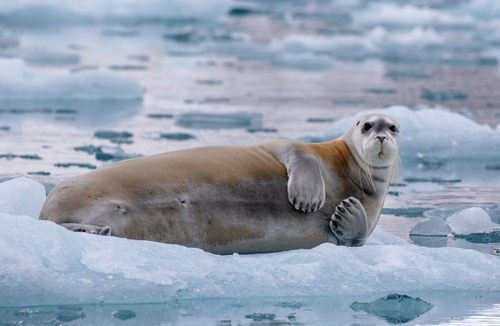
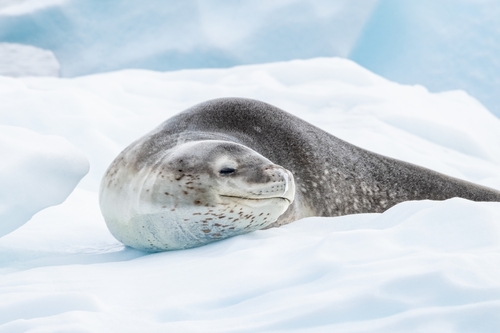
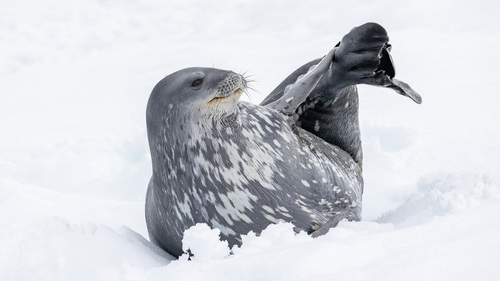
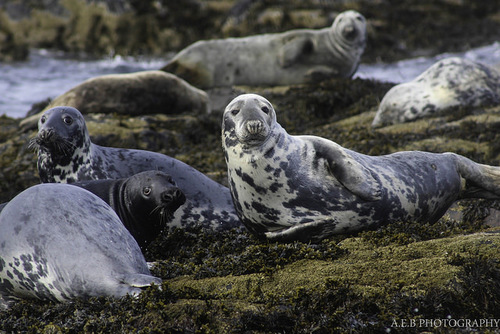
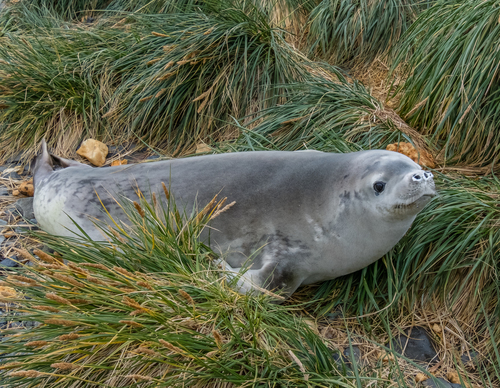
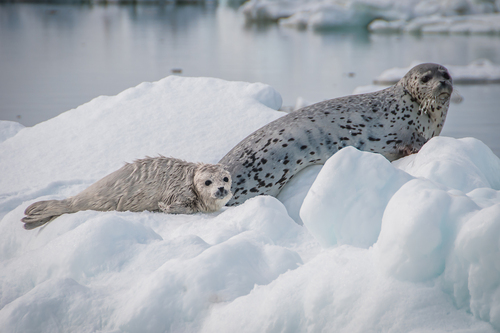
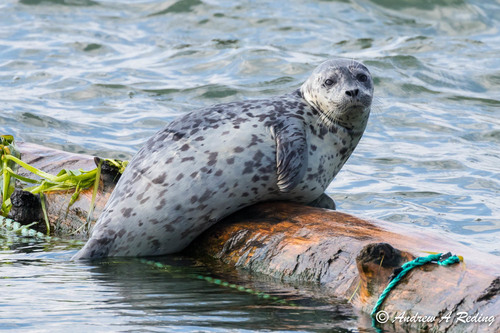
Each individual harbor seal (Phoca vitulina Linnaeus, 1758) has a unique spot pattern, with either dark spots on a light background or light spots on a dark background. Their color ranges from brownish black to tan or grey, and their underparts are generally lighter. They have short bodies and flippers, rounded heads, and distinctively V-shaped nostrils. Like other true seals, they have no pinna (ear flap), though the ear canal may be visible behind the eye. Adult harbor seals reach a total length (including the head and flippers) of up to 1.85 m (6.1 ft) and weigh between 55 and 168 kg (120 to 370 lb), and females are generally smaller than males. Harbor seals prefer to regularly use familiar resting sites. They can spend several days at sea and travel up to 50 km to find feeding grounds, and will also swim more than a hundred miles upstream into fresh water in large rivers to search for migratory fish such as shad and salmon. Their resting sites can be rugged rocky coasts (like those of the Hebrides or the shorelines of New England) or sandy beaches (like those that flank Normandy in Northern France or the Outer Banks of North Carolina). Harbor seals often gather in harbours, bays, sandy intertidal zones, and estuaries to hunt prey including fish such as salmon, menhaden, anchovy, sea bass, herring, mackerel, hake, cod, whiting and flatfish, and occasionally shrimp, crabs, mollusks, octopus, and squid. Atlantic subspecies from either Europe or North America also use deeper-dwelling fish of the genus Ammodytes as a food source, and Pacific subspecies have been recorded occasionally consuming fish of the genus Oncorhynchus. Although they are primarily coastal, dives of over 500 m have been recorded. Harbor seals have been recorded to attack, kill and eat several kinds of ducks. Harbor seals are solitary, but are social when hauled out onto land and during the breeding season, though they do not form groups as large as some other seals. When they are not actively feeding, they haul out to rest. They tend to stay coastal, and do not venture more than 20 km offshore. Their mating system is not confirmed, but is thought to be polygamous. Females give birth once per year, with a gestation period of around nine months. Females have a mean age at sexual maturity of 3.72 years and a mean age at first parturition of 4.64 years. Both courtship and mating take place under water. Researchers have observed that males gather under water, turn onto their backs, put their heads together, and call to attract females ready for breeding. The pregnancy rate of females was 92% from age 3 to age 36, with reproductive success lowering after the age of 25 years. Pups are born annually on shore. The timing of the pupping season varies by location: it occurs in February for populations in lower latitudes, and as late as July in the subarctic zone. Mothers are the sole caregivers for pups, and lactation lasts 24 days. Harbor seals give birth to a single well-developed pup, which is capable of swimming and diving within hours of birth. After suckling for three to four weeks on the mother's rich, fatty milk, pups grow rapidly: they are born weighing up to 16 kg, and may double their weight by the time they are weaned. Harbor seals must spend a great deal of time on shore when molting, which happens shortly after breeding. This extended time on shore is important to their life cycle, and can be disrupted when there is substantial human presence. The timing when molting begins depends on the animal's age and sex, with yearlings molting first and adult males molting last. A female mates again immediately after her pup is weaned. Harbor seals are sometimes reluctant to haul out when humans are present, so shoreline development and public access must be carefully studied, and managed if necessary, in known seal haul out locations. Compared to many pinniped species, and in contrast to otariid pinnipeds, harbor seals are generally considered to be more quiet vocally. However, they do use non-harmonic vocalisations to defend breeding territories and attract mates at specific times of year, as well as to communicate during mother and pup interactions. Annual survival rates have been calculated as 0.91 for adult males, and 0.902 for adult females. The maximum recorded age is 36 years for females and 31 years for males.