About Phlox multiflora A.Nelson
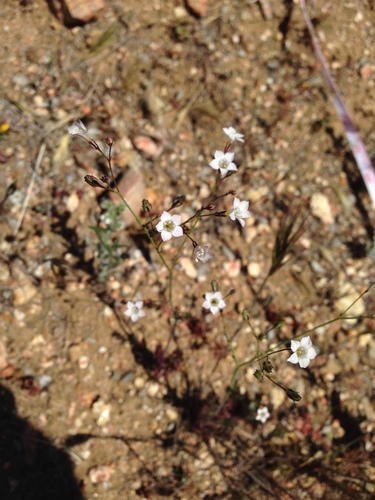
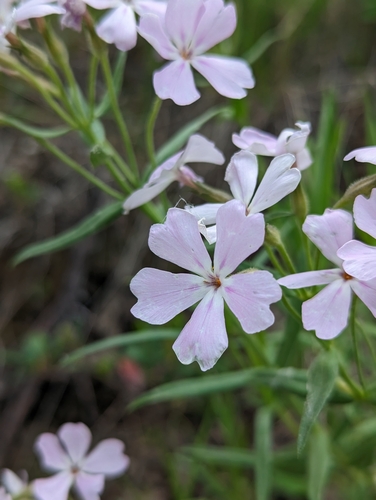
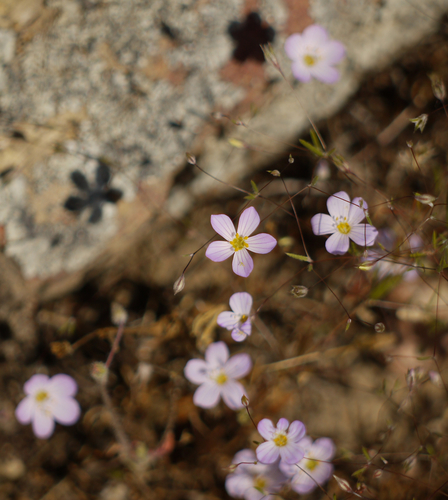
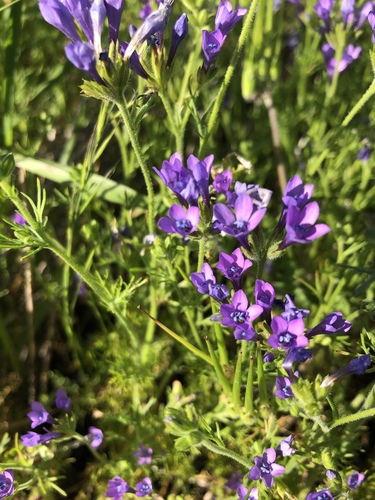
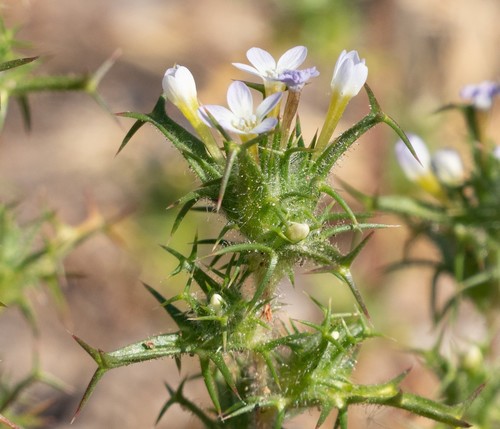
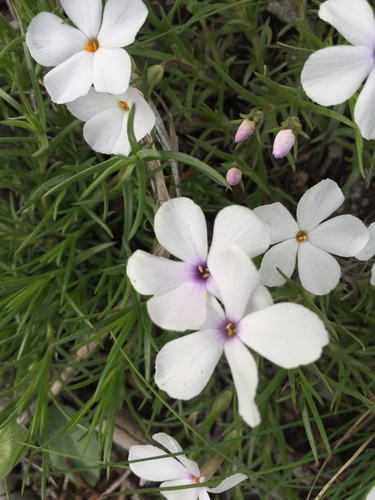
Phlox multiflora A.Nelson, commonly called Rocky Mountain phlox, is a low-growing perennial plant that grows from a taproot. Its main woody stems trail along the ground, reaching up to 30 centimeters (12 inches) long, and individual plants are most typically 8–25 cm (3–10 in) wide. Shorter branches grow from these main stems and are covered in leaves. Numerous stems rarely reach even 15 centimeters (6 in) tall, and grow packed together to form a loose mat that is around 5 to 10 cm (2 to 4 in) high. In some areas, large groups of this plant can form extensive cover over shrubby hillsides. Mature leaves are thin and needle-like, measuring just 1–2 millimeters wide and usually 12–30 mm long, though the longest leaves may occasionally be only 10 mm long. Leaf surfaces are often hairless, but may have a slightly rough grainy texture, or be slightly ciliate with a fringe of hairs along the leaf edges. Leaves grow in pairs attached to opposite sides of the stems. When in bloom, the entire surface of the plant can become covered in a carpet of flowers. The flowers are salverform: petals open out to a flat surface, and join at the base into a downward-extending tube at a right angle. Each flower has five petal lobes, five sepals, and a three-lobed style. Flower petals can be lilac, pale blue, pink, or white. The flower tube measures 10–14 mm long, while each petal lobe measures 6–11 mm. Stamens may either sit entirely within the floral tube, or extend slightly out of it. If a flower has a pedicel (flower stalk), it is short. Flowers grow in groups of one to three at the ends of stems. In its native habitat, blooming can start as early as May and continue as late as August, with the start of blooming depending on site elevation and orientation: north-facing slopes bloom considerably later than south-facing slopes. While it is similar to spiny phlox (Phlox hoodii), its leaves are much less stiff. Rocky Mountain phlox is native to eight western US states. In north-central New Mexico, the USDA Natural Resources Conservation Service only records it from Mora County. It is widespread in western Colorado, with more records in north-central areas, and a second concentration of records in the central mountains. In Wyoming, it occurs in every county across the western two-thirds of the state. In Montana, it grows mostly in southwestern mountain counties, though there are also records from northern Flathead County. In Idaho, its range covers the northeastern mountains and eastern part of the state. While native to Oregon, it is only recorded from Union County in the state’s northeast. It is known from five northern Utah counties: Box Elder, Rich, Summit, Daggett, and Uintah. Further west, it only occurs as a disjunct population in the Jarbidge Mountains of Elko County, Nevada. It usually grows in fairly rocky areas, and can be found in both open and wooded habitats ranging from above the timberline down to the highest foothills, at elevations between 2,200 and 3,265 meters (7,218–10,712 ft). It is associated with habitats dominated by sagebrush, quaking aspens, Rocky Mountain ponderosa pine forests, Douglas-fir forests, and lodgepole pines. In traditional Cheyenne medicine, as documented by George Bird Grinnell and his collaborators, Rocky Mountain phlox is used as a mild stimulant. Pulverized leaves and flowers are infused in warm water; the resulting liquid is rubbed into the body of a person experiencing numbness, and a small amount may also be drunk as a tea. Rocky Mountain phlox is grown in native plant gardens, though like other western US cushion phloxes it is not a common garden plant. Gardeners value it for the pleasant scent of its flowers. It can be propagated both by seed and by dividing mature plants in autumn. Colorado-based author Lauren Springer notes it requires dry conditions and grows successfully in sunny locations, while Australian writer and botanist Frances Bodkin states it is intolerant of drought and prefers moist, loamy soil.