About Phlox divaricata L.
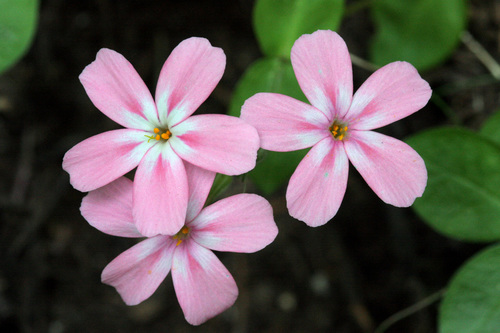
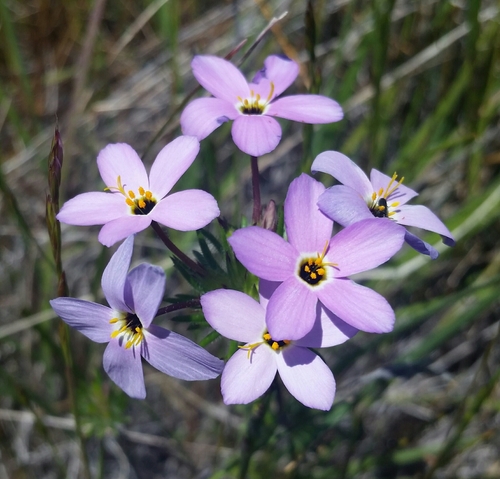
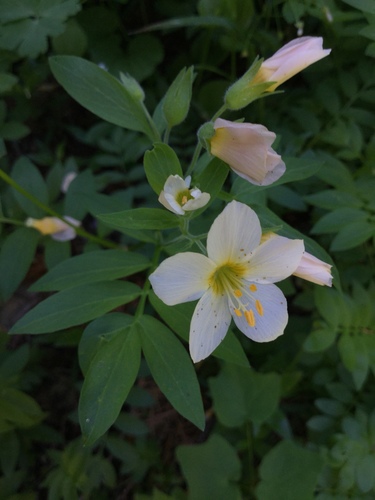
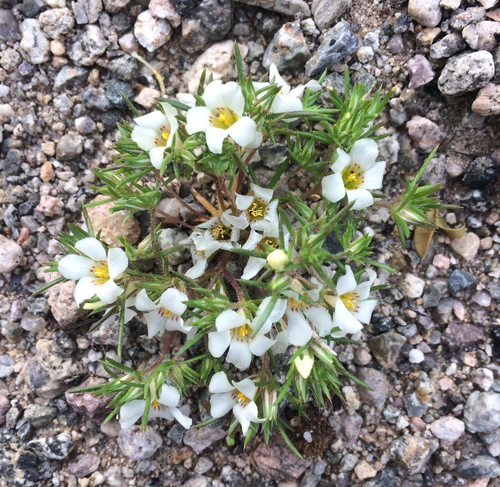
Wild blue phlox (Phlox divaricata L.) is a semi-evergreen perennial plant that grows 25–50 cm (10–20 in) tall. It has opposite, stalkless, hairy leaves that measure 2.5–5 cm (1–2 in) long and are ovate-lanceolate in shape. Flowers emerge in late spring and early summer, with a blooming period from March to May. The blooms are pleasantly fragrant, 2–4 cm (3⁄4–1+1⁄2 in) in diameter, and have five petals fused at the base into a thin tube. Petals come in a range of pastel shades: blue-lavender, light purple, pink, or white. This species grows in moist deciduous woods and bluffs. It has two recognized subspecies: P. divaricata ssp. divaricata has petals notched at the tip, while P. divaricata ssp. laphamii has unnotched petal tips. In ecological communities, wild blue phlox is most common during the climax successional stage. Its flowers produce nectar at the base of the long, narrow corolla tube, and pollen near the end of the corolla tube. Only butterflies, moths, skippers, and long-tongued bees have tongues long enough to reach the nectar. Short-tongued bees and flower flies cannot access the nectar, but they may gather or feed on the pollen. Wild blue phlox is self-incompatible, meaning it requires cross-pollination to produce seed. Butterflies are its most effective pollinators: when a butterfly inserts its proboscis into the flower to drink nectar, the proboscis contacts the anthers and picks up pollen. As the butterfly coils its proboscis before moving to the next flower, most pollen falls off, but some remains to transfer to the stigma of the next flower the butterfly visits for nectar. Numerous cultivated varieties of this species exist with different flower colors. These include the blue cultivar 'Blue Moon', the lavender cultivar 'Clouds of Perfume', and the white cultivars 'Fuller's White' and 'White Perfume'. The species Phlox divaricata itself and the lavender-flowered cultivar 'Chattahoochee' have both been awarded the Royal Horticultural Society's Award of Garden Merit.