About Phlegmacium glaucopus (Schaeff.) Wünsche
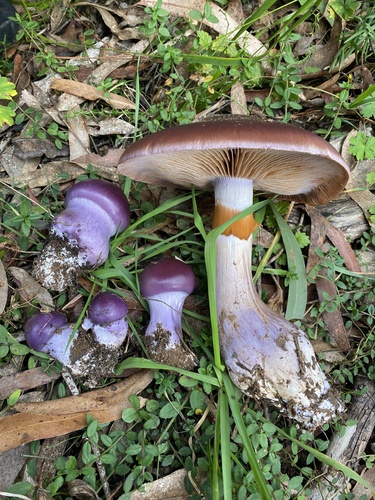
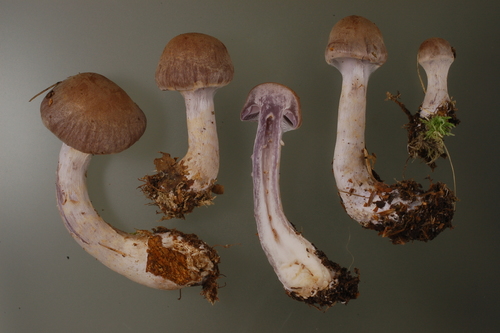
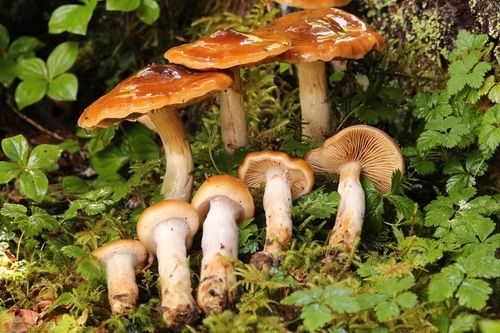
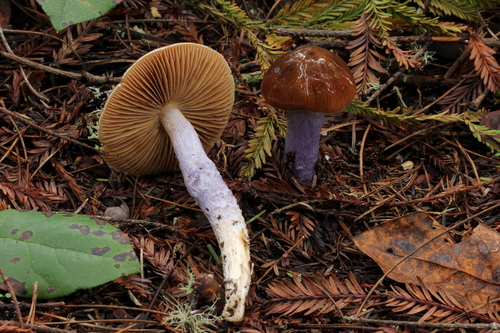
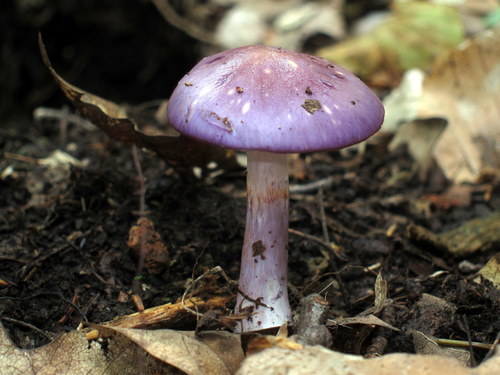
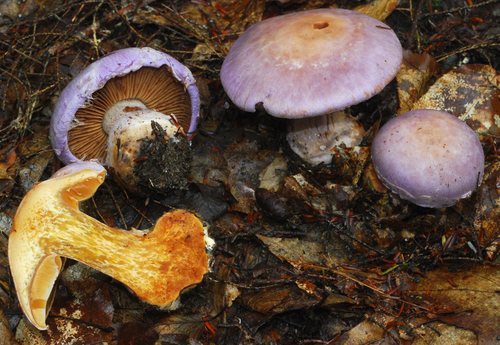
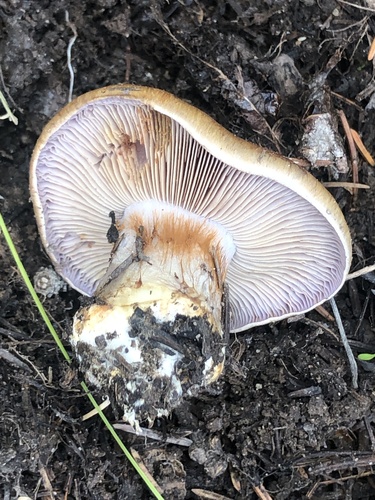
The fruit bodies of Phlegmacium glaucopus have convex caps 4 to 12 cm (1.6 to 4.7 in) across. The caps are ochre or tawny, marked with prominent darker brown fibres. Like other species in the Phlegmacium genus, young P. glaucopus mushrooms have a web-like veil called a cortina connecting the cap margin to the stipe. The stipe is bulbous, growing 4–10 cm tall and 1–3 cm wide. It is pale lilac-blue when young, with lower sections fading to yellow-white over time. The fungus's flesh is yellow-white, with a blue tint in the upper portion of the stipe. Its gills are lilac-blue, and are either adnate or free; they turn brown as spores mature. If an odor is detectable, it is slightly mealy. The spore print of P. glaucopus is red-brown, and individual spores measure 6.5–8.5 by 4.5–5 μm. Phlegmacium glaucopus fruits starting in August and continuing through autumn, growing in both deciduous and coniferous forests, often in large numbers. It can form fairy rings. This species occurs in Western North America, in both the United States and Canada, and is common in the Rocky Mountains. It is rare east of the Great Plains, and also rare in the British Isles. P. glaucopus forms ectomycorrhizae that are unusually water-repellent (hydrophobic) compared to those of other fungi, which has spurred scientific interest in sequencing its genome. DNA studies suggest the species may break down toxic polycyclic aromatic compounds in soil using specially adapted oxidizing enzymes.