About Phintelloides versicolor (C.L.Koch, 1846)
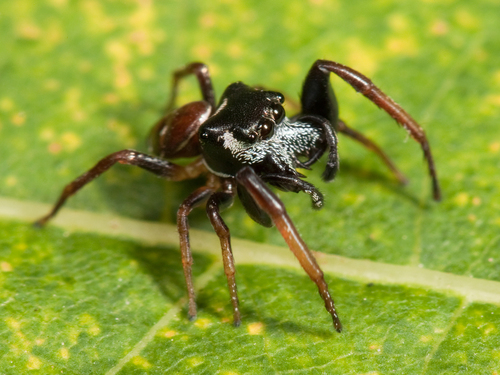
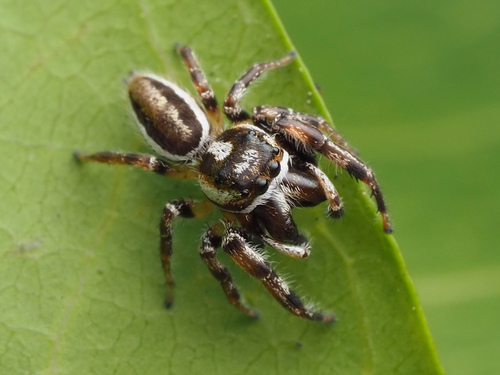
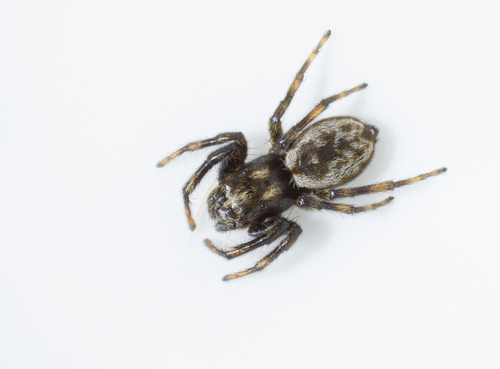
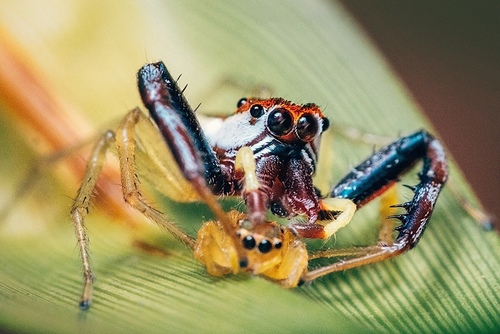
Phintelloides versicolor shows sexual dimorphism in both coloration and pattern. Both sexes have distinctive flattened white hairs on the clypeus, and this feature is more pronounced in females. Females have a frontal strip of thick white flattened setae that spans the full width of the carapace, while males only have a small white "moustache" below the anterior median eyes.
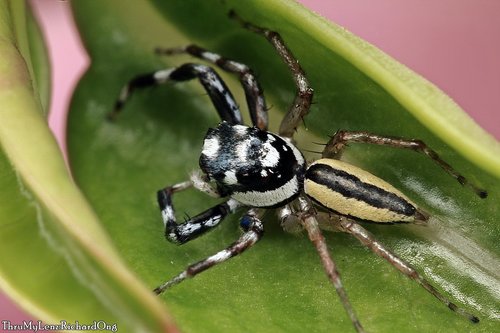
This species can be easily identified by its characteristic abdominal pattern. In males, the abdomen has a dark central band bordered by white lateral bands that appear yellow in living specimens. This pattern is the reverse of the pattern seen in most related species from the Chrysilla and Phintella genera, and this reversed color pattern is the reason for the species' Latin name "versicolor". The thoracic region of males has a wide submarginal band with dark edges; in live male specimens, the thorax is black with two central white patches and several smaller white patches.
Females differ notably in appearance: the posterior thorax of the carapace has a pair of black semi-rings set against a light background. The dorsal surface of the female abdomen is pale, marked with irregular cinnamon-brown blotches and a central white band. Males generally have a total body length between 4.4 and 6.3 mm; a detailed measurement of a male collected from Sam Roi Yot National Park recorded a total length of 4.70 mm, a carapace length of 2.30 mm, and a carapace width of 1.80 mm. Male legs are dark with light rings on the tibia, metatarsus, and tarsus, while female legs and palps are pale.
P. versicolor has a broad distribution across tropical Southeast Asia. It has been documented in Pakistan, India, Myanmar, Thailand, Vietnam, Malaysia, Singapore, Brunei, and Indonesia (Sumatra). Confirmed specific localities include Selangor (Malaysia), Lim Chu Kang (Singapore), and Kanchanaburi Province, Prachuap Khiri Khan Province, and Chiang Mai (Thailand). The species has been found in a range of habitats, including limestone forests, at elevations from sea level up to roughly 300 meters.