About Philydor rufum (Vieillot, 1818)
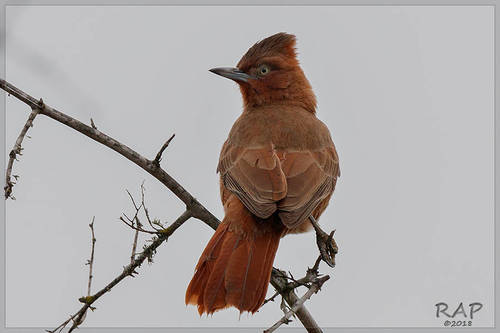
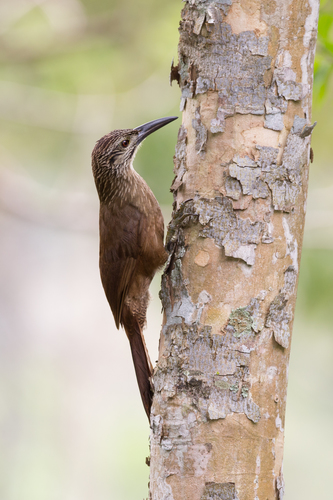
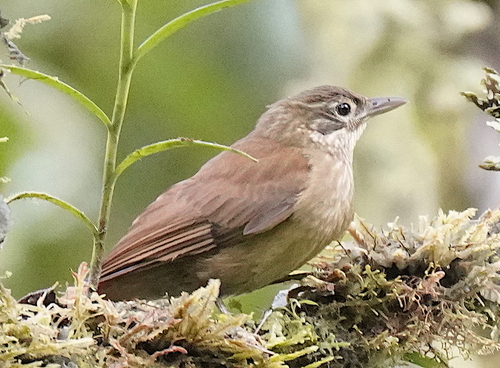
The buff-fronted foliage-gleaner, with scientific name Philydor rufum (Vieillot, 1818), measures 18 to 19 cm (7.1 to 7.5 in) long and weighs 25 to 36 g (0.88 to 1.3 oz). It is a relatively large furnariid, and males and females have identical plumage. For the nominate subspecies, adults have an ochraceous forehead that extends into a wide supercilium, a dark brownish gray line behind the eye, dark brownish gray lores, and ochraceous ear coverts and malars. The crown behind the forehead is dull brownish gray with very faint paler streaks. The upper back is dull brownish gray, transitioning to ochraceous brown on the lower back. The rump and uppertail coverts are a slightly paler shade of ochraceous brown. The wings are mostly bright rufous, with darker primary coverts. The tail is dull rufous-brown and has pointed feather tips. The throat and breast are a vivid glowing ochraceous, which fades to a duller ochraceous on the belly, flanks, and undertail coverts. The iris ranges from grayish brown to dark brown to chestnut; the maxilla is blackish to dark grayish; the mandible is silvery gray to olive; and the legs and feet are olive to grayish green. Juveniles have a narrower forehead band than adults, plus a paler crown and darker, more rufescent underparts. There are multiple recognized subspecies with distinct physical traits. D. r. chapadensis has a deeper ochraceous forehead than the nominate, along with a paler gray crown that has a few ochraceous spots, and richer back coloring. D. r. boliviana has a paler, more olivaceous crown instead of gray, unlike the nominate. D. r. riveti is smaller than the nominate, with a darker crown and back, a more rufous tail, and a brownish wash over the breast and belly. D. r. columbiana has a narrower, duller buff forehead band than the nominate, an olivaceous crown, a darker back, and a much paler belly. D. r. cuchiverus is similar to columbiana, but shares the nominate's ochraceous forehead. D. r. panerythra has a paler, more grayish crown and back than cuchiverus, with deeper, more uniformly ochraceous underparts. This species has a highly disjunct distribution across at least seven general geographic areas, with smaller isolated populations within some of these areas. Each subspecies occupies a separate range: D. r. panerythra occurs sparsely in the highlands of Costa Rica and Panama, as well as in the Central and Eastern Andes and the separate Serranía de San Lucas of Colombia; D. r. riveti ranges from Colombia's Western Andes south through most of western Ecuador; D. r. columbiana is found in Sierra de San Luis and the Coastal Range of northern Venezuela; D. r. cuchiverus is restricted to Cerro Calentura and Cerro El Negro in southern Venezuela; D. r. boliviana occurs along the east slope of the Andes from Napo Province in Ecuador south through eastern Peru into central Bolivia; D. r. chapadensis is found mostly in the Brazilian states of Mato Grosso and Goiás, and has also been recorded in Tocantins; the nominate D. r. rufa is found in eastern and southeastern Brazil from Bahia south to Rio Grande do Sul, extending west and south through Mato Grosso do Sul and eastern Paraguay into northeastern Argentina. Populations in Central America, northern South America, and the Andes live in humid foothill and montane forest. In Central America, the species occurs at elevations between 800 and 2,500 m (2,600 and 8,200 ft), and in northern and western South America it occurs between 600 and 2,000 m (2,000 and 6,600 ft). In southeastern South America, the species inhabits tropical lowland evergreen forest and gallery forest, ranging from near sea level mostly to 1,000 m (3,300 ft), and locally up to 1,200 m (3,900 ft).