About Philydor lichtensteini Cabanis & Heine, 1859
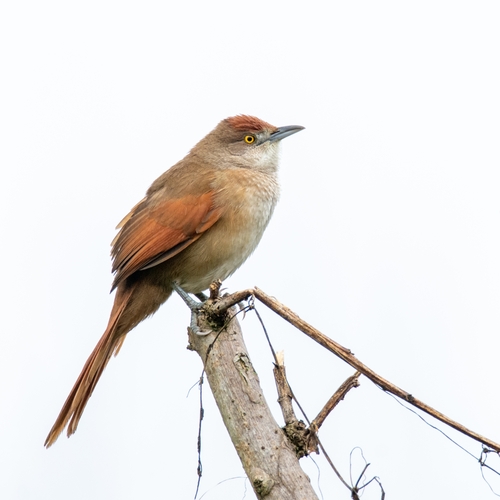
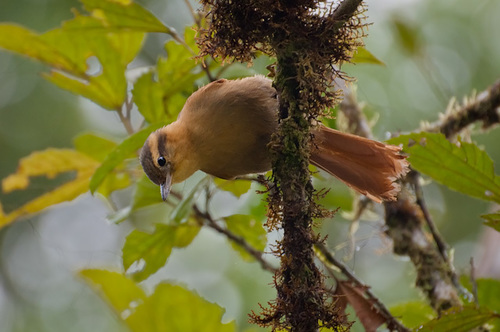
The ochre-breasted foliage-gleaner (scientific name Philydor lichtensteini Cabanis & Heine, 1859) is 15 to 17 cm (5.9 to 6.7 in) long and weighs 18 to 24 g (0.63 to 0.85 oz). It is a medium-sized furnariid with a wedge-shaped bill that is the shortest in its genus. Males and females have identical plumage. Adults have an ochraceous eye ring and sharply defined supercilium, a dark brownish band behind the eye, dull rufous-ochre ear coverts, and pale brownish lores. Their crown is dull gray-brown with vague paler streaks, their back is rufescent brown, and their rump and uppertail coverts are a slightly lighter rufescent brown. Their tail is mostly rufous, with rufescent brown outer webs on the innermost pair of tail feathers. Their wings are rufous brown, with duskier tips on the flight feathers. Their throat and malar area are bright ochraceous buff, their upper breast a richer ochraceous buff, and the rest of their underparts a duller ochraceous buff. Their iris is brown, their maxilla brownish gray, their mandible light gray, and their legs and feet greenish gray. Juveniles have less uniformly colored underparts than adults, and juvenile underpart feathers have grayish tips.
The ochre-breasted foliage-gleaner is distributed in southeastern Brazil from Bahia, Goiás, and Mato Grosso do Sul south into Rio Grande do Sul, as well as in eastern Paraguay and northeastern Argentina's Misiones Province. It inhabits montane evergreen forest and tall secondary forest, and occurs at elevations ranging from sea level to 800 m (2,600 ft).