About Philydor atricapillus (Wied-Neuwied, 1821)
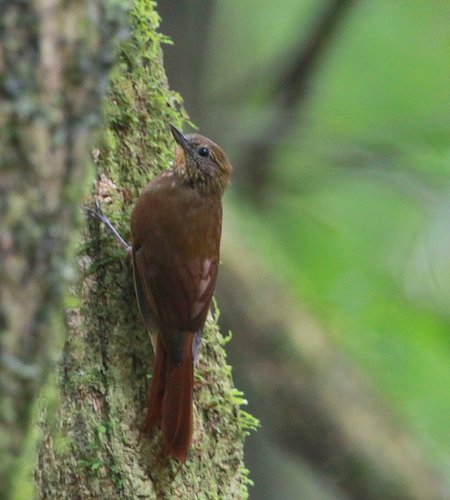
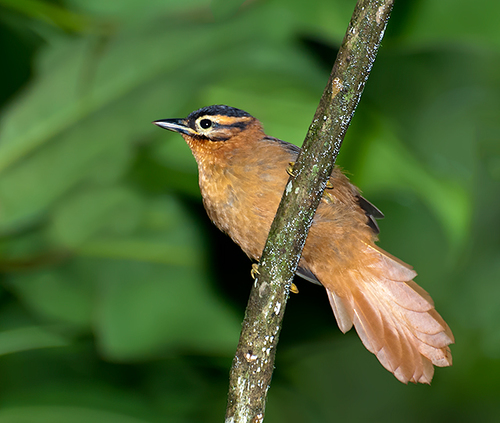
The black-capped foliage-gleaner, with the scientific name Philydor atricapillus (Wied-Neuwied, 1821), is 16 to 17 cm (6.3 to 6.7 in) long and weighs 17 to 27 g (0.60 to 0.95 oz). Males and females have identical plumage, which features a very distinctive facial pattern. Adult individuals have a wide pale buff eyering, and a pale buff supercilium that becomes more orange-rufous toward the rear. They have a blackish-brown stripe behind the eye, dull buffy rufous lores, and pale buff ear coverts with blackish-brown bands positioned both above and below the coverts. The species' crown is dark brown, with faint spots on the forehead and faint streaks along its center. The back is rich rufous-brown, the rump is slightly paler than the back but more rufous in tone, and the uppertail coverts are bright orange-rufous. The tail is bright rufous. The wings are mostly rich brown, with darker coverts and dark fuscous tips on the flight feathers. The chin, throat, and malar area are light orange-rufous. The breast and belly are solid dark orange-rufous; the flanks are slightly duller than the breast and belly, while the undertail coverts are bright rufous. The iris is brown, the maxilla is blackish, the mandible ranges from pale gray to greenish gray, and the legs and feet range from pale ochre-yellow to light olive-gray. Juvenile birds closely resemble adults, but have dark brown edges on the feathers of their underparts. The black-capped foliage-gleaner is distributed from Bahia in Brazil, extending south through Mato Grosso do Sul and Rio Grande do Sul to eastern Paraguay, and reaches slightly into Misiones Province in northeastern Argentina. It lives in tropical evergreen forest and mature secondary forest, at elevations ranging from sea level to approximately 1,000 m (3,300 ft).