About Philotheca verrucosa (A.Rich.) Paul G.Wilson
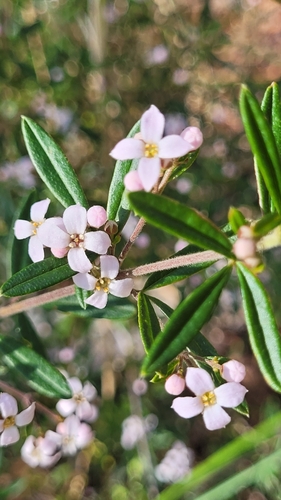
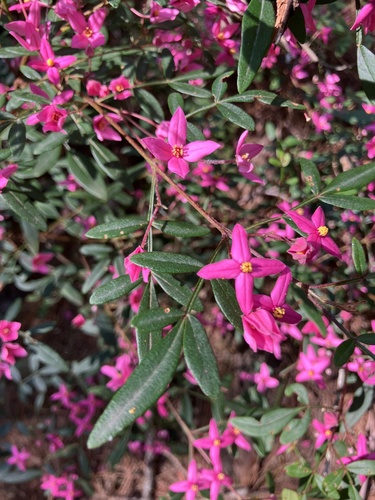
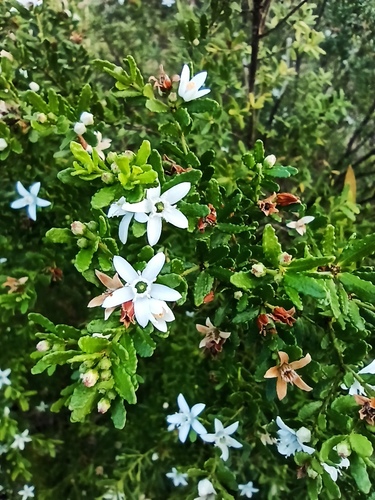
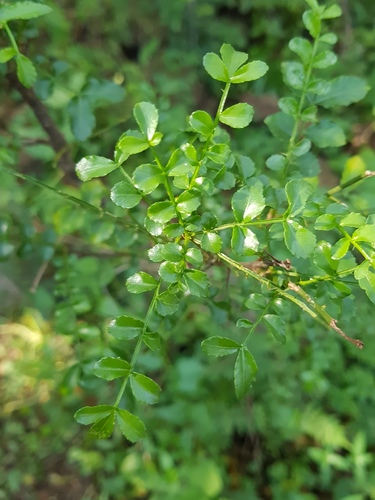
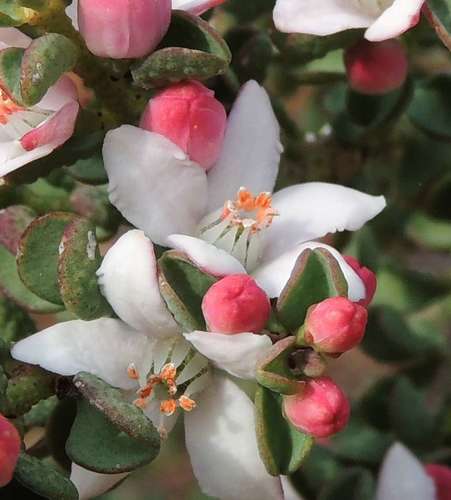
Philotheca verrucosa (A.Rich.) Paul G.Wilson is a shrub or undershrub that typically grows to around 80 cm (31 in) tall, and rarely reaches up to 2 m (6 ft 7 in). Its branchlets are prominently covered in glandular warts. The species has sessile leaves that range from heart-shaped to egg-shaped, with the narrower end positioned toward the base. Each leaf is 6–15 mm (0.24–0.59 in) long and 4–7 mm (0.16–0.28 in) wide, with glandular warts on its lower surface. Leaves are either flat or folded lengthwise. Flowers are most often arranged singly in leaf axils, growing on a peduncle 0.5–2 mm (0.020–0.079 in) long, with a pedicel 1–4 mm (0.039–0.157 in) long. It has five more or less round, fleshy sepals that are about 1 mm (0.039 in) long. The five petals are white, elliptic, and about 6 mm (0.24 in) long, while the ten stamens are covered in hairs. Flowering takes place from August to October. Philotheca verrucosa grows on rocky hills in forest and woodland, and sometimes grows in sandy heathland. It occurs in South Australia, Victoria, and Tasmania. In South Australia it is found in the Mount Lofty Ranges; in Victoria it occurs in the Grampians, Bendigo district, and Gippsland; and it is found in eastern Tasmania. In horticulture, this philotheca can be propagated from tip cuttings, is frost hardy, and is reasonably drought-tolerant. Some cultivated forms have double or multiple whorls of petals. The hybrid cultivar Philotheca 'Flower Girl' is thought to be a cross between P. verrucosa and Philotheca myoporoides. This cultivar produces a profusion of light pink to white flowers during winter and spring, and grows to between 1 and 2 metres high.