About Philotheca myoporoides (DC.) Bayly
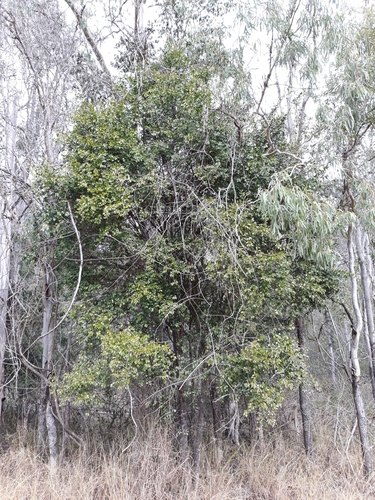
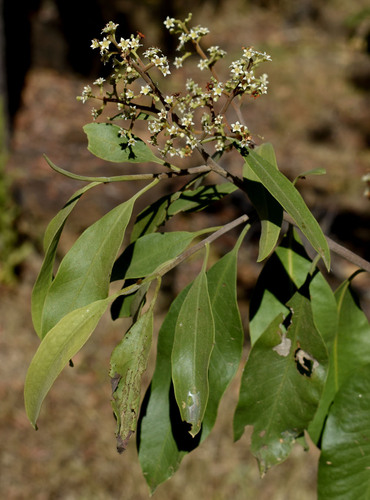
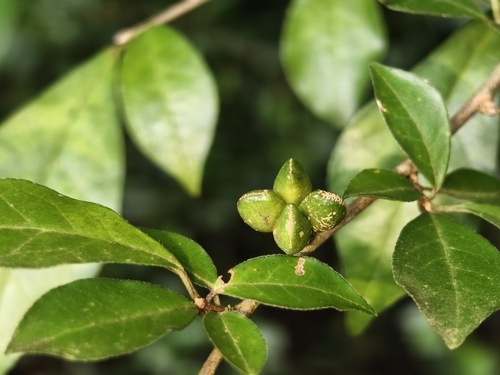
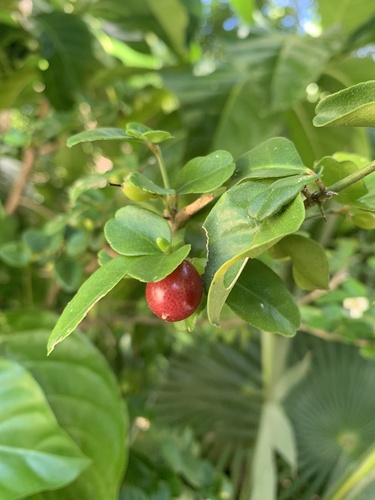
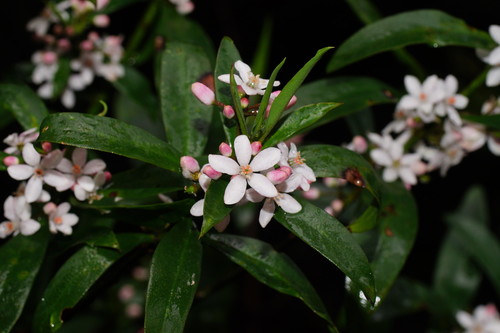
Philotheca myoporoides (DC.) Bayly is a species of shrub that typically grows to 2 metres (6 feet 7 inches) in height. Its leaves are sessile, oblong to broadly egg-shaped, covered in glandular warts, and have a texture ranging from papery to leathery. The leaves measure 15–110 mm (0.59–4.33 in) long and 4–20 mm (0.16–0.79 in) wide, with a prominent midrib. Flowers are arranged singly or in groups of up to eight, produced in leaf axils on a peduncle up to 20 mm (0.79 in) long. Each individual flower sits on a pedicel that is 1–10 mm (0.039–0.394 in) long. The sepals are broadly triangular, about 1 mm (0.039 in) long and 1.5–2 mm (0.059–0.079 in) wide. The petals are white to pink, about 8 mm (0.31 in) long, with a prominent keel. Flowering occurs mainly in spring and autumn, and the fruit is about 7 mm (0.28 in) long, with a beak around 3 mm (0.12 in) long.
Different subspecies of Philotheca myoporoides have distinct distribution and habitat ranges. Subspecies acuta grows on rocky sandstone hills from Lockhart to near Cobar. Subspecies brevipedunculata occurs in coastal areas to mountain summits between Sassafras and Moruya in south-eastern New South Wales. Subspecies euroasa grows among granite boulders on the Strathbogie Ranges near Euroa in north-eastern Victoria. Subspecies myoporoides grows in forest and heathland, usually near watercourses, mostly along the Great Dividing Range from the northern border of New South Wales to near Healesville in Victoria. Subspecies petraea is only known from rocky areas on Mount Stewart, west of Gelantipy in north-eastern Victoria.
Caterpillars of the orchard butterfly feed on this species. In horticulture, the species adapts well to cultivation, and commercial plants are available at nurseries in Australia. It prefers a well-drained position in light shade. Established plants tolerate both dry periods and moderate frost. Plants can be propagated from semi-mature cuttings, though some forms root slowly.