About Philotheca difformis (A.Cunn. ex Endl.) Paul G.Wilson
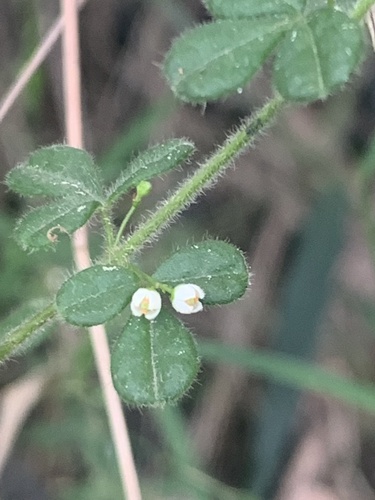
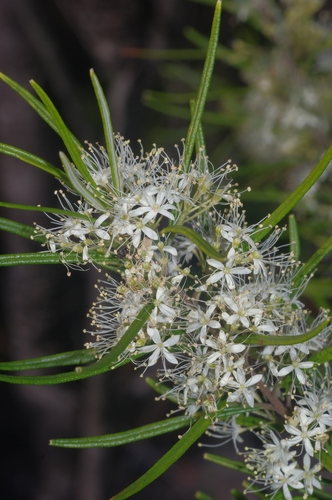
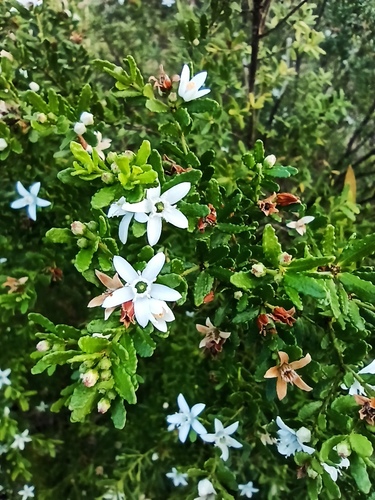
Philotheca difformis is a shrub that typically reaches a height of 1 to 2 meters (3 ft 3 in to 6 ft 7 in), and it produces glandular-warty branchlets. Its leaves are fleshy, hairless (glabrous), covered in glandular warts, and attached to a short petiole. Leaf size and shape vary between the two recognized subspecies. Subspecies difformis has fleshy, more or less cylindrical leaves that measure around 8 mm (0.31 in) long and 1 mm (0.039 in) wide. Subspecies smithiana has flat, more or less egg-shaped leaves that measure around 4 mm (0.16 in) long and 2 mm (0.079 in) wide. Flowers are borne singly or in clusters of two to four at the ends of branchlets, with each flower attached to a pedicel 2 to 3 mm (0.079–0.118 in) long. This species has five fleshy, triangular sepals and five oblong white petals that are 4 to 5 mm (0.16–0.20 in) long and have a thick midrib. Its ten stamens are covered in dense, woolly hairs. Flowering occurs sporadically throughout the year, and the resulting fruit is around 5 mm (0.20 in) long, with a warty texture and a beaked tip. In terms of distribution and habitat, Philotheca difformis subspecies difformis grows in rocky woodland areas, and occurs mainly in inland parts of south-east Queensland, inland New South Wales, north-west Victoria, and the Flinders Ranges in South Australia. Subspecies smithiana most often grows on rock outcrops, and is found near the coast in south-east Queensland, and in north-eastern New South Wales as far south as Singleton.