About Philaeus chrysops (Poda, 1761)
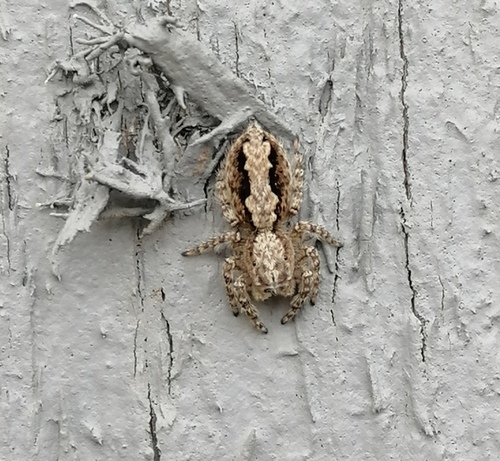
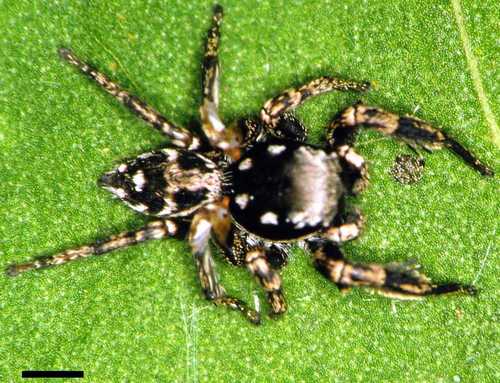
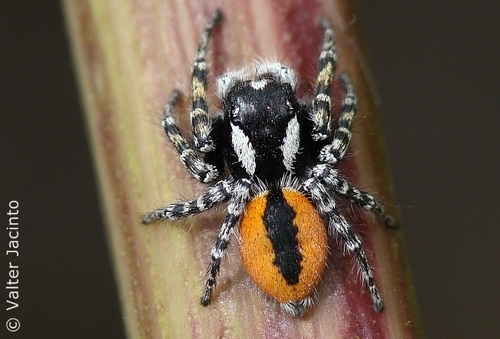
Philaeus chrysops is a jumping spider species first described by Poda in 1761. Most adult individuals have a normal body length of 7–12 millimeters (0.28–0.47 inches), though small males as small as 5 mm can occur. Unusually for spiders, males of this species are often larger than females, and this species exhibits extreme sexual dimorphism in coloration and patterning. Males are highly colorful, with a bright red opisthosoma; the species epithet chrysops means "golden eye" in Greek. Males have a dark brown or blackish cephalothorax, which usually has two broad longitudinal white stripes positioned behind the rear eyes. The dorsal and lateral surfaces of the male abdomen are bright orange-red, with a central longitudinal black stripe and black markings on the shoulder region. Male legs are long and slender, mostly dark, with bright orange-red patellae and most of the tibiae on the first two pairs of legs. The female's cephalothorax shares the same base pattern as the male's, but the characteristic white stripes are much smaller. The dorsal surface of the female abdomen is mostly covered by a very broad, somewhat irregular brown band, which bears two longitudinal whitish stripes and a small number of additional whitish marks near the abdominal edges. The remaining parts of the abdomen and the abdominal sides may be orange-brown or pale brown, and female legs are light brown marked with dark brown rings. Philaeus chrysops is distributed across the Palearctic realm, ranging from Portugal in the west to South China and Korea in the east. It is quite common across most of Europe, particularly in southern European countries. It has not been recorded from Ireland, Iceland, and multiple other northern European regions, including most of Scandinavia, Estonia, Latvia, and Northern European Russia. Outside of Europe, it can be found in North Africa, the Near East, Turkey, the Caucasus, Central Asia, Iran, Afghanistan, China, Mongolia, and Korea. This spider species favors open, warm environments. It is most commonly found in dry, rocky or sandy habitats that support low, open vegetation.