About Philaethria dido wernickei (Röber, 1906)
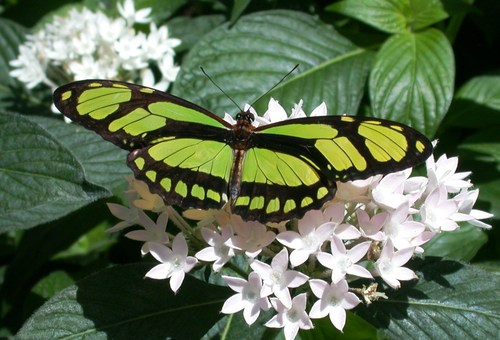
This subspecies of butterfly, Philaethria dido wernickei, has an average wingspan of approximately 110 mm (4.3 in). In Mexico, adult butterflies are active on the wing from July through December. The upper surface of its wings is black, marked with a pattern of translucent green patches. The underside of the wings has a similar base pattern, and additionally features brown streaks alongside gray scales. Philaethria dido is frequently confused with the butterfly species Siproeta stelenes, as the two share similar coloration. However, they can be distinguished by their differing wing shapes, as well as their differing flight behaviors and habitats: P. dido flies high in the forest canopy, while S. stelenes is most often found in forest clearings and open secondary forest. The related subspecies Philaethria dido chocoensis is endemic to land west of the Andes Mountains, with a range that stretches from western Ecuador to the Chocó region in northwestern Colombia. The nominate subspecies Philaethria dido dido has a much broader distribution. It is native to tropical forests east of the Andes in South America, with a range extending from Brazil to Bolivia and Colombia, and reaching northward as far as Mexico. Occasional stray individuals of this butterfly have been observed in the lower Rio Grande valley of Texas, United States. This butterfly has a fast, direct flight pattern. It mostly moves quickly through the forest canopy and along stream courses, but it can also be spotted in clearings and sunlit glades. It occurs in tropical rainforests at altitudes ranging from sea level up to 1200 metres (4000 ft), and is not found in deciduous forests.