About Phidippus whitmani G.W.Peckham & E.G.Peckham, 1909
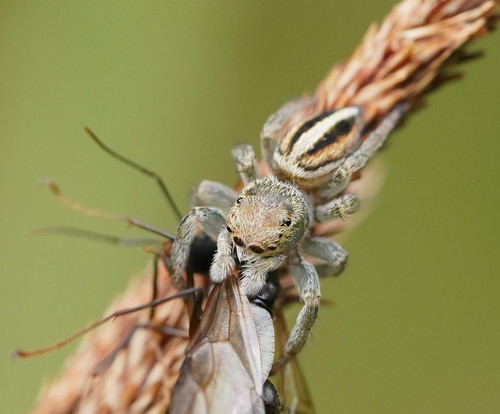
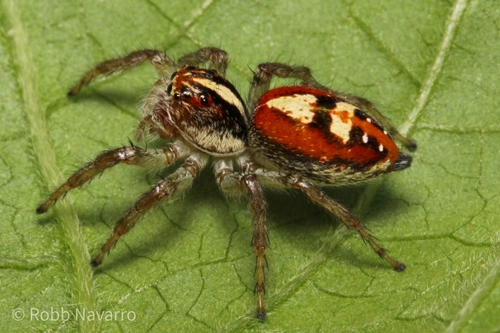
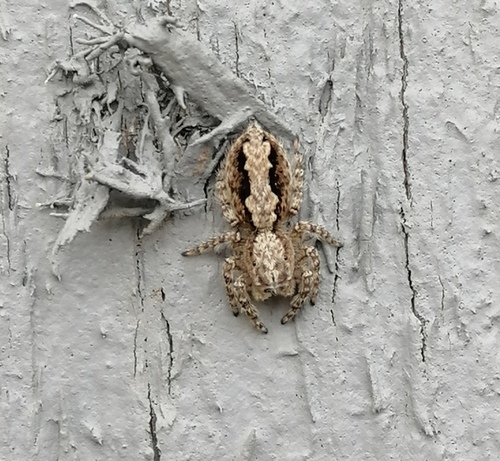
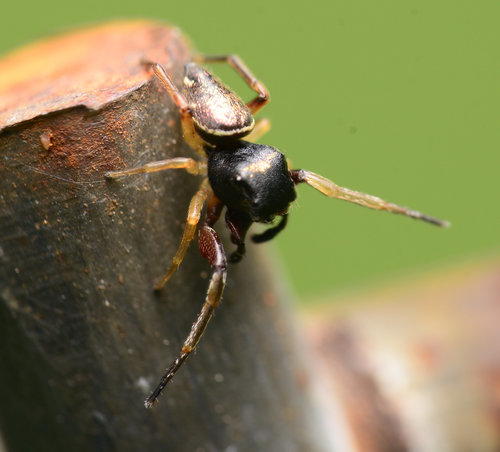
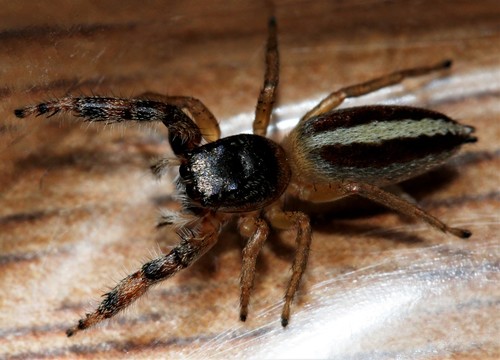
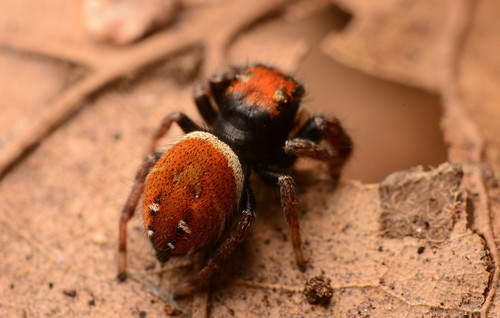
Phidippus whitmani is a jumping spider species that exhibits clear sexual dimorphism. Males have striking red coloration on the top of the abdomen and cephalothorax. They have a white band along the top of the abdomen, a lateral band that holds several small black or white spots in its center, a black band across the frontal eye region, and white setae on their forelegs. Their chelicerae are typically black, with a fringe of white. Females share the same general spotted and banded patterning as males, but their base body color varies by region: in the northern half of the species' total range, the abdomen and cephalothorax are typically brown, while females in the southern half of the range may be red. This species reaches maturity in May or June, and females typically lay eggs during July and August. Phidippus whitmani is distributed across the United States and Canada. In the United States, its range stretches from Florida in the south to New York and New Hampshire in the north, and extends west as far as Colorado. In Canada, it has been recorded across Nova Scotia, Newfoundland, Québec, Manitoba, and Ontario, and it is ranked as apparently secure within Ontario. It is most commonly found in older mixed hardwood forests, living in leaf litter or on herbaceous vegetation.