About Phidippus clarus Keyserling, 1885
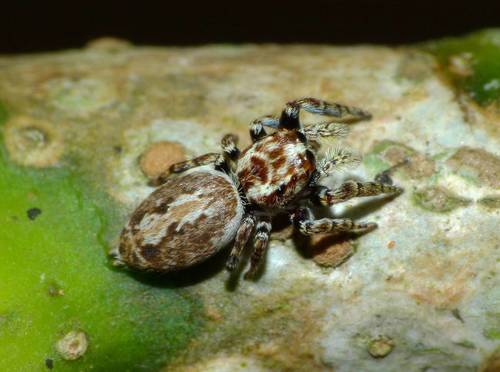
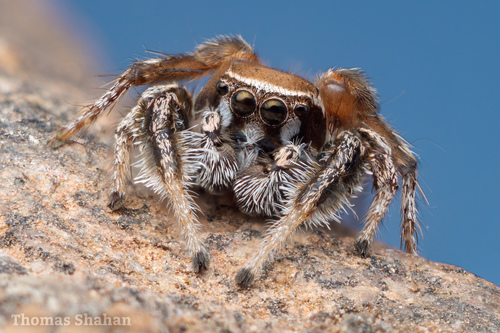
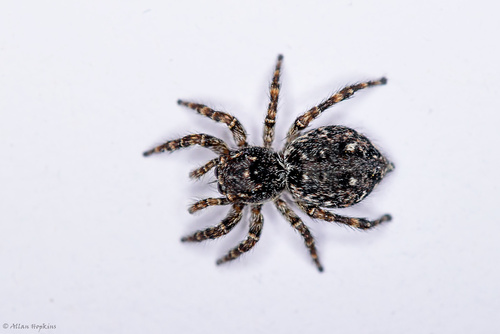
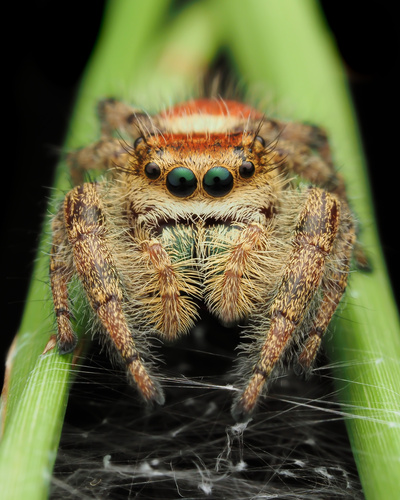
Phidippus clarus is a species of jumping spider. All jumping spiders have a characteristically distinctive rectangular carapace. For Phidippus clarus, female carapaces average 4.05 millimetres (0.159 in) wide, while male carapaces average 3.20 millimeters (0.126 in) wide. Their bodies are most commonly red or brown, but they may sometimes be a lighter yellow or brown with darker markings. This species occurs in old fields across most of the United States, southern Canada, and has also been recorded in western Mexico. It lives among flowers, and often shares its habitat with the small to medium-sized crab spider Misumena vatia, a species that waits to ambush its prey. Phidippus clarus typically waits upside down near the top of a plant, such as basil leaves; this position may help it detect prey and jump down quickly before prey can escape. In a 2002 survey of jumping spiders conducted in Minnesota, Phidippus clarus made up 52% of all jumping spiders found. Phidippus clarus reaches adulthood in early summer. Females that are ready to lay eggs can weigh up to 400 milligrams (0.014 oz). Early in the breeding season, from early to mid-July, there are more males than females, and all females reach sexual maturity at the same time. After this point in the breeding season, males die off, so that the number of males becomes equal to or slightly lower than the number of females. By August, most females spend increasingly long periods staying in their nests overnight, as these nests are the sites where they will lay eggs. Nests of Phidippus clarus are located inside rolled leaves and constructed from thick silk, which is a costly resource to use for nest building. The thick silk used to build nests also makes the species' egg sacs very conspicuous. Experiments have confirmed that female Phidippus clarus use visual landmarks to navigate back to their nests. A male will only stay in the same nest if he is paired with a female. Like other spiders and many other arthropods, Phidippus clarus vibrates surfaces to communicate with other members of its species. It often uses this vibration alongside other communication methods such as movement, to intimidate rival males and interact with potential mates.