About Phidippus californicus G.W.Peckham & E.G.Peckham, 1901
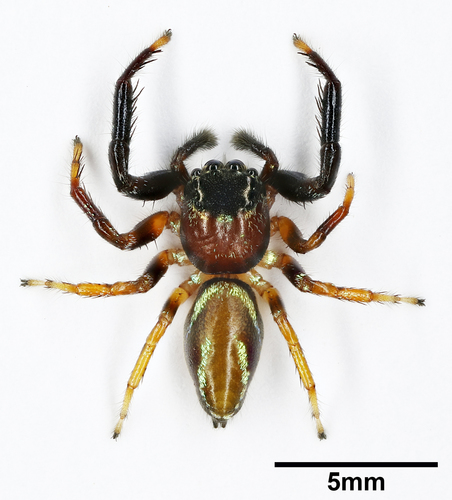
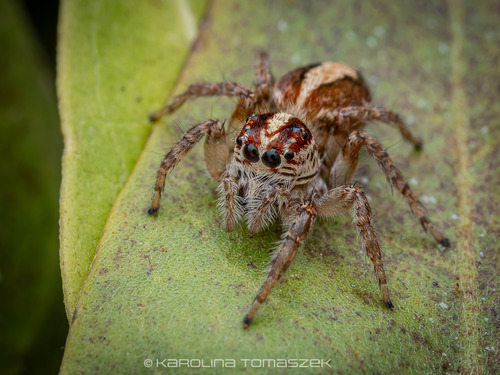
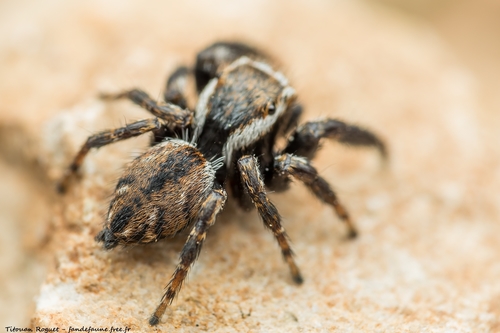
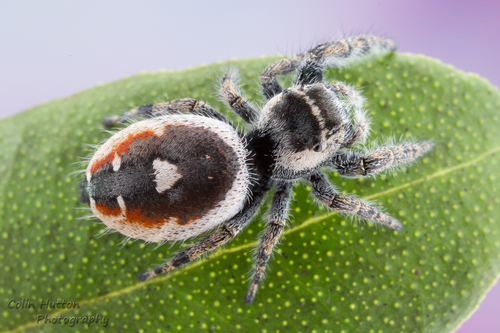
Phidippus californicus is a species of jumping spider first described by G.W.Peckham and E.G.Peckham in 1901. Adult females reach a maximum body length of 12 mm, while adult males range from 7 to 11 mm in body length. Both sexes share the same coloration: they have blue-green iridescent chelicerae, a black cephalothorax, black limbs, and a bright red abdomen marked with a central black stripe, a pattern similar to that of female Phidippus johnsoni. Two tiny white spots sit between the black and red areas on the back half of the dorsal abdomen. The abdomen also has light diagonal bands along its sides, plus a light transverse band across the anterior section of the dorsal surface. The visibility of these markings varies: the bands and spots may only be a slightly lighter red shade than the rest of the abdomen, while the central black stripe can shrink so much in width and length that the abdomen looks solid red. Occasionally, the base abdominal color is orange instead of red, and very old individuals may even be yellow. Unlike most other Phidippus species, where adult males have iridescent chelicerae and unique adult coloration while females retain a color pattern matching immature spiders (such as in P. clarus, P. octopunctatus, and P. whitmani), adult P. californicus males and females have similar coloration, just like in the related species P. apacheanus. P. californicus is one of several jumping spider species that mimic mutillid wasps of the genus Dasymutilla, commonly called velvet ants. Multiple Dasymutilla species match this spider in size and coloration, and the wasps have a very painful sting. Starting from the second instar, spiderlings have a brownish-gray cephalothorax and limbs, with a red abdomen that only has markings on its posterior portion. These markings consist of a pair of black stripes, each with two prominent white dots, separated by a light-colored area. This separating area can be gray, white, or even golden, and it widens into a noticeable light dot just in front of the black stripes. The abdomen of very young spiderlings looks bronze, but the red abdominal color becomes prominent in later instars. A red marking forms in the eye region during one of the later instars, either the 5th or 6th, but this marking disappears after the next molt. The light basal and side bands seen in adults are already present in immature P. californicus, and the chelicerae become iridescent in the two instars before maturity. This species lives in the sagebrush community of the Great Basin Desert. It is most often found on bushes including big sagebrush (Artemisia tridentata), gray rabbitbrush (Chrysothamnus nauseosus), and four-winged saltbrush (Atriplex canescens). P. californicus prefers bushes growing on slopes with thin, stony soils, and it avoids conifers and moist habitats such as areas near irrigation ditches. Two other Phidippus species, P. apacheanus and P. octopunctatus, share this habitat and are often found on the same individual bushes. For reproduction, adult males are active from early April to July, while adult females are active from early May to July. Females lay two to three successive batches of eggs, with each subsequent batch containing fewer eggs than the last. Around 40 eggs hatch from the first batch, 30 from the second, and few to none hatch from the third. Eggs hatch after approximately three weeks. Spiderlings stay inside the nest until after their first molt, which occurs a little over two weeks after hatching. Once they complete this first molt, they become self-sufficient.