About Phengaris teleius (Virgstrassir, 1779)
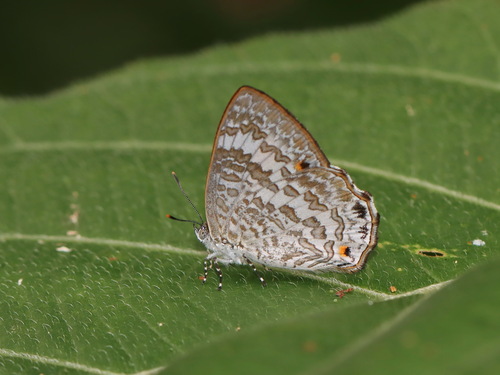
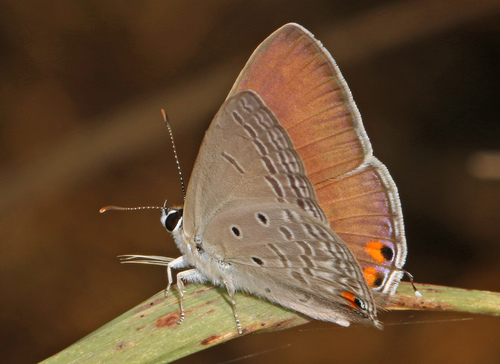
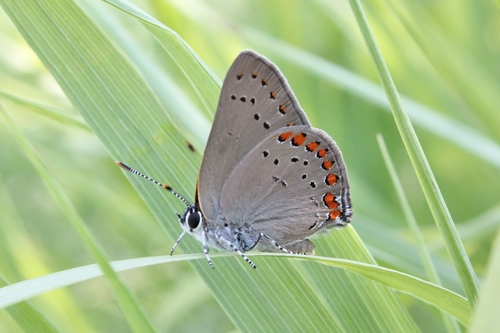
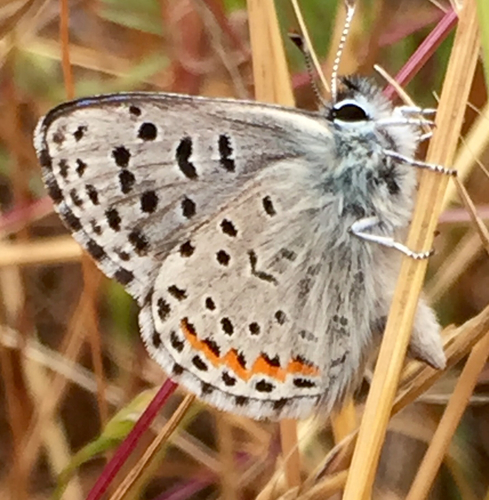
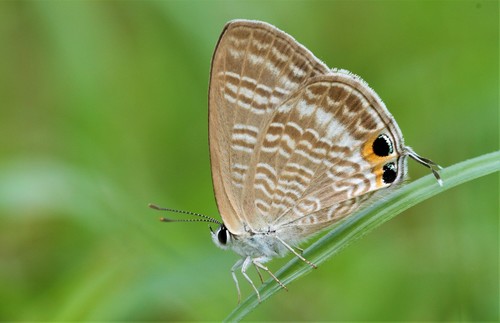
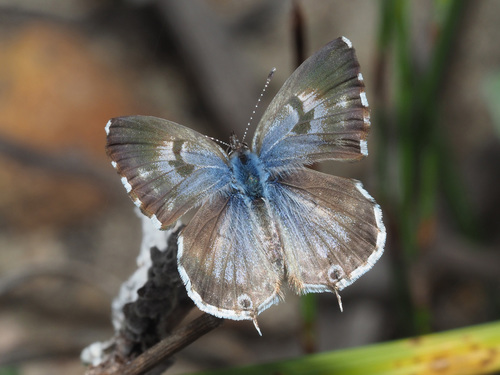
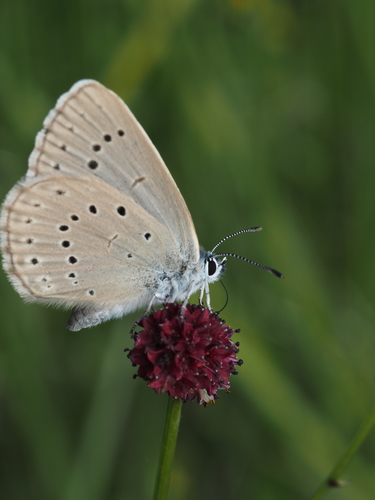
This species is described from Seitz as L. euphemus Hbn. (= diomedes Rott.) (83 a). Males have almost entirely blue uppersides that are not shining, with black margins, a black discocellular spot on the forewing, and commonly some small black spots on the disc. Females are much blacker, often slightly paler on the disc, and this lighter area has rows of black spots. The underside has very many ocelli, which are rarely as large and conspicuous as in the published figure of the underside. This species is immediately distinguished from the very similar Phengaris arion by the absence of an ocellus in the cell proximal to the discocellular spot on the underside. It is found across Europe except England, and in adjacent areas of Asia, ranging from northern Germany and Russia to Italy, and from Paris to Dauria. Near the north-western boundary of its range, there are especially small individuals matching the size of Polyommatus icarus that have only few ocelli; these are named aberration paula Schultz. In aberration obsoleta Gillm., the ocelli of the hindwing are completely or almost completely absent, while in aberration striata Gillm. the ocelli are modified into streaks. obscurata Stgr. (83 b) is a strongly darkened form from Central Asia, that also already occurs in the Ural. euphemia Stgr. (83 b) is much larger than European specimens, with a broad black border that sharply contrasts with the light blue ground colour; this form is found in Amurland, North China, and Corea. kazamoto Druce, which is now recognized as the separate species Phengaris kazamoto (H. Druce, 1875) (83 b) from Japan, has a uniformly black-brown upperside in both sexes with no trace of blue, and more strongly developed ocelli on the underside. Eggs are semiglobular with a sunken top, greenish white, and laid on Sanguisorba, usually on the inflorescence. Young larvae are purplish brown with a black head and pale segmental incisions; they bore into the flower heads of the food plant and later live in the seed pods, and hibernate. Pupation takes place on the ground, under stones, clods of earth, and dead leaves of the food plant. The butterflies are sporadic, with widely separated localities. They fly in damp meadows where Sanguisorba grows, and are usually very abundant in these sites. They settle almost exclusively on Sanguisorba: when disturbed, they mostly only fly as far as the nearest cluster of this plant, where they settle on a flower with their wings always closed. Their flight is rather slow and flapping. Adults fly in July and August.