About Phemeranthus teretifolius Raf.
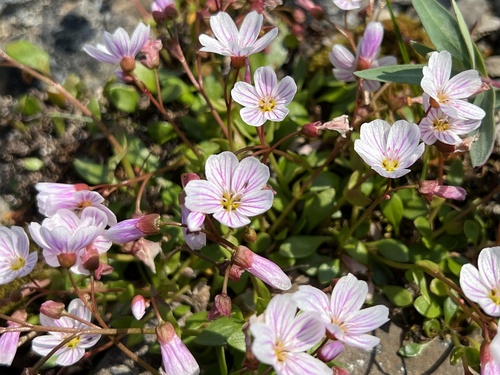
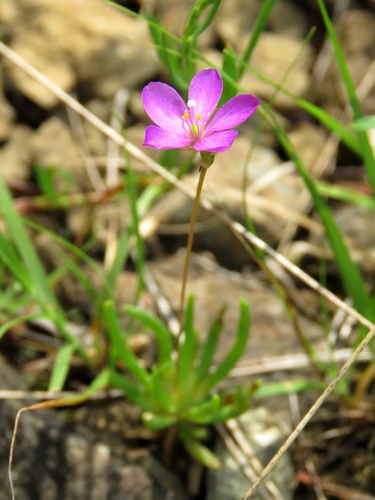
Quill Fameflower, scientifically named Phemeranthus teretifolius Raf., grows between 2 and 20 inches tall, and has weak, fleshy stems. Its leaves are arranged alternately along the stem, with spaces between individual leaves and grow in tightly packed clusters. These leaves are relatively round, and measure between 1.2 and 2.4 inches long. Flowers grow and bloom along the peduncle, most commonly with 5 petals. The flower petals are a bright pinkish-purple, often described as fuchsia or magenta. Only one or two flowers bloom per peduncle each day.
This species is endemic to the United States, and occurs across the eastern portion of the country, specifically in Alabama, Delaware, Georgia, Kentucky, Maryland, North Carolina, South Carolina, Pennsylvania, Tennessee, Virginia, and West Virginia.
Quill Fameflower has fleshy, succulent leaves that are adapted for water storage. It maintains deciduous green foliage, and prefers growing in full sun conditions. The species has almost no root system, and is highly drought tolerant, which makes it well suited for growing in rocky or sandy soil. It has cosexual flowers that contain both staminate and pistillate reproductive structures, so it is not self-incompatible and can self-fertilize. Individual flowers open for only one day, starting around 3pm EST and closing before nightfall. A single Quill Fameflower individual can produce more than one hundred flowers. Flowering starts in April and continues through October, and the species is primarily pollinated by bees. Because the flower only blooms for a few hours each day, if it is not fertilized by a bee within this short window, it will close at night and self-fertilize instead. This short-lived plant grows mostly in open areas with thin, very rocky or sandy soil, typically formed from sandstone or granite.